

Front desk cash handling errors can create missing revenue, incorrect patient balances, refund disputes, and audit problems that remain undetected for months. Medical administrators handle more than physical currency. They process copayments, card transactions, deposits, patient credits, and financial adjustments that must reconcile with billing records. A reliable process requires accurate transaction posting, secure payment collection, documented approvals, and independent verification. This guide explains essential cash handling terminology, practical reconciliation examples, fraud prevention controls, and daily closing procedures using medical front desk practices, healthcare compliance systems, and administrative workflow automation.
1. Front Desk Cash Handling Fundamentals: How Medical Practices Control Patient Payments
Front desk cash handling includes receiving, recording, securing, transferring, reconciling, and documenting payments collected directly from patients. These activities occur across reception counters, self-service kiosks, online payment portals, and integrated practice management systems.
The principal financial risk arises when money changes hands without a corresponding, accurate, traceable transaction.
A receptionist may collect a $40 copayment, issue a receipt, and place the money in the register. However, if the payment is posted against the wrong encounter, the cash drawer may balance while the patient's account remains incorrect.
Another employee may record a cash payment in the practice management system without placing the corresponding currency in the drawer. The patient account appears paid, but the physical cash is missing.
These examples demonstrate why medical practices need separate controls for payment collection, patient-account posting, physical custody, and bank reconciliation.
Understanding written administrative documentation, clinical system integration, staff communication procedures, and healthcare technology troubleshooting helps administrators investigate discrepancies without confusing them with unrelated billing problems.
The four financial records that should agree
Every patient payment should be traceable through four independent records or evidence sources.
1. Transaction record: Identifies the payment amount, method, date, employee, transaction reference, and patient account.
2. Patient ledger: Shows how the payment was applied to the correct account, encounter, charge, or outstanding balance.
3. Payment evidence: Includes a cash receipt, payment processor confirmation, check record, or another approved document demonstrating collection.
4. Settlement or deposit record: Establishes how funds entered the merchant or banking system and identifies outstanding differences requiring reconciliation.
An effective healthcare automation workflow should connect these records through traceable identifiers. Staff should also follow confidential financial communication, professional front desk standards, and appropriate healthcare cybersecurity controls.
Cash handling responsibilities and separation of duties
A well-controlled practice distributes payment activities across authorized employees wherever staffing permits.
The individual receiving cash should ideally be different from the individual preparing deposits or conducting independent reconciliation. Similarly, the employee approving refunds should be separate from the person initiating them where practical.
Smaller practices may lack sufficient staff for complete separation. In those situations, compensating controls might include independent managerial review, daily transaction exception reports, restricted refund permissions, and periodic unannounced cash counts.
A useful control matrix identifies who can collect payments, issue refunds, void transactions, modify account balances, prepare deposits, and reconcile bank statements.
These responsibilities should be reinforced through medical administrative professionalism, team communication training, healthcare compliance software, and workflow access management.
| # | Cash Handling Term | Definition & Practical Example | Administrative Control |
|---|---|---|---|
| 1 | Cash Drawer | A secured register compartment holding currency and coins collected during an assigned shift. | Assign drawer ownership and follow front desk procedures. |
| 2 | Opening Float | Fixed starting currency amount retained in the drawer for making change, such as $150. | Count and document the float during opening records. |
| 3 | Tender Type | Payment method used for a transaction, such as cash, card, check, or an approved electronic method. | Post the correct method and verify payment system mappings. |
| 4 | Point-of-Sale (POS) Terminal | Device or system used to accept and process patient payments. | Inspect terminals and report unusual behavior under payment security procedures. |
| 5 | Payment Receipt | Confirmation of a payment, identifying the amount, method, date, and transaction reference. | Issue receipts consistently and protect patient financial information. |
| 6 | Copayment | A fixed cost-sharing amount due under applicable insurance benefit rules, such as a $25 office-visit copay. | Verify the visit type and plan conditions before explaining charges. |
| 7 | Deductible | Amount a patient may owe toward covered services before specified insurance benefits apply. | Confirm the applicable benefit and avoid presenting estimates as final patient charges. |
| 8 | Coinsurance | Patient cost-sharing percentage applied under plan terms, often to an allowed service amount. | Check the appropriate base amount and communicate through professional financial discussions. |
| 9 | Patient Ledger | Account history recording charges, payments, contractual adjustments, credits, and outstanding balances. | Match transactions to the correct patient and encounter in connected practice systems. |
| 10 | Payment Posting | Recording a received payment against the proper patient account, charge, or outstanding balance. | Verify encounter matching and posting rules. |
| 11 | End-of-Day Close | Procedure for completing, balancing, and documenting daily financial activity. | Require completed closing documentation and supervisory review. |
| 12 | Cash Over/Short | Difference between physically counted cash and the amount expected from approved records. | Log every variance, investigate its cause, and maintain audit evidence. |
| 13 | Cash Reconciliation | Comparison of physical cash with recorded receipts and authorized cash movements. | Use independent review and documented handoffs. |
| 14 | Cash Drop | Transfer of collected currency from the register into approved secure storage. | Record amount, time, transferring employee, and recipient under custody procedures. |
| 15 | Deposit Slip | Record identifying the amount and composition of funds submitted for bank deposit. | Match the slip with register totals and deposit records. |
| 16 | Chain of Custody | Documented sequence showing who controlled funds throughout collection, transfer, storage, and deposit. | Use signed transfers and traceable records. |
| 17 | Segregation of Duties | Separating authorization, custody, recording, and reconciliation responsibilities to reduce error and fraud risk. | Review user permissions and approval workflows. |
| 18 | Dual Control | Two authorized individuals jointly perform or verify a sensitive action, such as counting a large deposit. | Document both participants through accountability procedures. |
| 19 | Void Transaction | Cancellation of a transaction before final processing or settlement, depending on system behavior. | Require justification, authorization, and a preserved transaction audit trail. |
| 20 | Refund | Return of an eligible overpayment or other amount owed to a patient or payer. | Verify entitlement, original tender, and approval under financial controls. |
| 21 | Chargeback | Cardholder-initiated dispute that can result in funds being reversed through the card payment process. | Preserve payment evidence and minimize disclosed information under privacy procedures. |
| 22 | Merchant Batch | Group of card transactions submitted for payment processing or settlement. | Reconcile batch totals and check terminal discrepancies. |
| 23 | Settlement | Payment processing stage in which authorized card transactions are finalized for funding. | Distinguish transaction approval from completed settlement in financial integrations. |
| 24 | Patient Credit Balance | Credit recorded on an account that may represent an overpayment or other adjustment requiring review. | Verify source and ownership before refunding, transferring, or applying it through approved procedures. |
| 25 | Unapplied Cash | Payment received but awaiting correct allocation to an account, charge, or other approved destination. | Investigate aging items through exception queues. |
| 26 | Contractual Adjustment | Account adjustment resulting from applicable payer agreements or adjudication terms. | Restrict adjustment authority and preserve supporting documentation. |
| 27 | Bad-Debt Write-Off | Approved accounting adjustment addressing a balance classified as uncollectible under applicable policies. | Require appropriate approval separate from routine payment collection. |
| 28 | Petty Cash | A separately controlled small cash fund for authorized incidental expenses. | Keep petty cash separate from patient receipts and record expenditures under financial policies. |
| 29 | PCI DSS | Payment Card Industry Data Security Standard, establishing requirements to protect applicable payment account data. | Use approved terminals and follow card data security controls. |
| 30 | Tokenization | Replacement of sensitive payment data with a token that can support approved payment workflows. | Verify vendor implementation and payment data exposure. |
| 31 | HSA/FSA Payment | Payment from a health savings or flexible spending account, subject to applicable eligibility rules. | Provide accurate receipts and refer eligibility questions using patient communication procedures. |
| 32 | Daily Deposit Reconciliation | Comparison of collections, documented deposits, and eventual bank credits. | Investigate unmatched amounts using independent financial review. |
| 33 | Audit Trail | System record of transaction creation, access, modification, approval, and relevant user activity. | Retain searchable activity logs through compliance reporting. |
| 34 | Form 8300 | U.S. federal report generally required when a business receives more than $10,000 in cash in one or related transactions. | Escalate qualifying activity to financial compliance staff and verify applicable reporting obligations. |
2. Step-by-Step Front Desk Cash Handling: From Patient Payment to Bank Deposit
Medical practices should follow a standardized payment workflow that begins before the first patient arrives and ends only when collections have been reconciled to financial records.
Step 1: Verify the opening cash float and assign drawer custody
Before collecting payments, the assigned employee should count the opening float and compare it with the authorized starting amount.
Suppose a drawer is required to contain $150. The receptionist counts $145.
The $5 difference must be documented and investigated before accepting new payments. Otherwise, the employee may be incorrectly held responsible for a discrepancy originating during an earlier shift.
A suitable opening record includes the date, employee identifier, drawer identifier, verified amount, discrepancy, and supervisor acknowledgment when required.
Shared access should be minimized. If several employees use the same drawer, transaction-level accountability becomes difficult unless the system supports separate user identification and controlled handoffs.
These opening procedures should be integrated with professional front desk workflows, written administrative records, team accountability procedures, and healthcare compliance controls.
Step 2: Verify the amount due before collecting payment
Payment amounts should be based on applicable insurance information, adjudicated balances, verified patient responsibility, or clearly identified estimates.
For example, an insurance plan may indicate a $30 specialist copayment. Staff should confirm that the amount applies to the scheduled visit and that another relevant rule does not change the expected collection.
Deductibles and coinsurance require particular care because the final amount can depend on the allowed charge, benefit accumulation, and claim processing.
A patient with a remaining deductible may receive an estimate that differs from the eventual adjudicated responsibility.
Staff should distinguish confirmed balances, estimated balances, and amounts pending insurance processing.
Accurate patient scheduling information, patient registration systems, verbal financial explanations, and healthcare compliance software support this verification.
Step 3: Accept the payment and issue an accurate receipt
Once the amount is confirmed, the employee should select the appropriate patient account, encounter, transaction type, and payment method.
Suppose a patient pays an $85 balance using $35 in cash and $50 by card.
The system should record two payment tender entries linked to the same account or transaction group.
The patient ledger should reflect a total payment of $85, while the cash register should recognize only $35 in physical cash.
A payment receipt should provide sufficient information to identify the transaction and allow the patient to confirm the amount paid. Receipts should follow applicable privacy and card-data protection requirements.
Staff should avoid placing unnecessary diagnosis, treatment, or sensitive medical details on general payment receipts.
These procedures rely on accurate administrative documentation, patient confidentiality practices, secure payment systems, and professional patient communication.
Step 4: Reconcile physical cash separately from electronic payments
At the end of the shift, count physical currency and compare it against the opening float, recorded cash receipts, and approved cash movements.
Card transactions, checks, and electronic transfers should be reconciled using their respective reports.
A card transaction processed for $100 increases recorded patient collections but does not increase the amount of currency in the drawer.
Mixing all payment types into one expected physical total creates artificial discrepancies.
For better accountability, the closing procedure should produce separate figures for cash, checks, card transactions, refunds, voids, and unapplied payments.
These reports should reconcile with practice management records, workflow automation data, administrative exception reports, and financial compliance documentation.
Step 5: Secure funds and document transfer of custody
After reconciliation, collected currency should be transferred to approved secure storage or prepared for deposit according to organizational policy.
A documented transfer should identify the amount, date, time, drawer or deposit identifier, and individuals involved.
Tamper-evident deposit bags and dual verification may be appropriate depending on cash volume and organizational risk.
The receiving employee should verify the handoff using an approved procedure. Unexplained discrepancies should remain visible until investigated and resolved.
These controls strengthen professional accountability, team communication, written financial records, and compliance monitoring.
Step 6: Match recorded deposits against actual bank credits
The final financial control occurs when deposited funds are compared with bank activity.
Suppose the practice prepares a deposit containing $920 in currency and $180 in checks.
The deposit total is $1,100.
If the bank subsequently credits only $1,080, the $20 difference requires investigation.
Potential causes include an incorrectly prepared deposit, a counting error, a check adjustment, or a bank processing issue.
The practice should preserve the deposit documentation, investigate the specific difference, and record any authorized correction.
The employee conducting bank reconciliation should ideally be independent of routine cash custody and deposit preparation.
3. Cash Reconciliation Examples: Calculating Shortages, Split Payments, and Patient Credits
Practical reconciliation requires administrators to understand how financial transactions affect several accounts simultaneously.
The following examples show how to identify discrepancies and prevent incorrect adjustments.
Example 1: Calculate an end-of-day cash shortage
A receptionist begins the day with an opening float of $150.
During the shift, the practice records $327 in cash receipts and processes an approved $20 cash refund.
Expected closing cash is calculated as:
\[ 150+327-20=\$457 \]
The employee counts $449 in the drawer.
CASH RECONCILIATION EXAMPLE
Opening float$150Cash receipts$327Approved cash refund−$20Expected closing cash
$457
Actual cash counted$449
Cash shortage
$8
The cash over/short calculation is:
Actual cash − expected cash = $449 − $457 = −$8.
The negative result represents an $8 shortage.
The supervisor should review receipt history, refund records, cash handoffs, and possible counting errors.
The shortage should be recorded through the appropriate financial control account or exception procedure. Employees should not silently change patient transactions or add personal funds to make the drawer balance.
This process relies on healthcare compliance reporting, written incident documentation, team escalation procedures, and professional cash handling practices.
Example 2: The drawer balances while the patient account remains wrong
A patient pays $45 in cash. The receptionist issues a valid receipt and places the currency in the register.
However, the payment is accidentally posted to another patient with a similar name.
At closing, physical cash matches the recorded cash transactions. The drawer shows no shortage.
Yet one patient has an unexpected $45 outstanding balance, and another has a $45 credit.
This illustrates the importance of distinguishing cash custody reconciliation from patient ledger reconciliation.
An appropriate review compares payment references, verified patient identifiers, encounter records, and posting history.
Authorized staff should correct the misapplication through an auditable adjustment that preserves the original transaction and its correction.
Strong patient identification workflows, electronic records management, administrative technology controls, and confidential communication procedures help prevent these mistakes.
Example 3: A card transaction appears approved but never settles
A patient makes a $120 card payment.
The payment terminal initially displays an approval, and the practice management system posts the amount.
Later, the card processor's settlement report does not include the transaction.
Possible causes include an unsettled batch, reversed authorization, integration failure, or posting error.
Administrators should identify the processor reference, authorization status, batch record, settlement result, and applicable bank funding information.
An approved authorization should be distinguished from a completed settlement and actual bank credit.
Staff should follow approved reconciliation procedures before attempting to charge the patient again, because duplicate charges can create disputes.
Knowledge of medical admin technical troubleshooting, healthcare cybersecurity, workflow automation, and patient communication standards supports an accurate investigation.
Example 4: An insurance adjustment creates a patient credit
A patient pays $100 at check-in toward an estimated responsibility.
After claim adjudication, the confirmed patient responsibility is $55.
Assuming there are no other outstanding balances, required offsets, or applicable restrictions, the account contains a potential $45 overpayment.
\[ \$100-\$55=\$45 \]
Before refunding, the billing team should verify the finalized claim, payment source, relevant remittance information, and organizational refund requirements.
The account may require reconciliation if more than one payer, guarantor, or payment source is involved.
A patient credit should also be distinguished from unapplied cash, which may represent an unidentified or incorrectly allocated payment.
Administrators can coordinate these reviews through healthcare compliance systems, secure patient communication, medical administrative documentation, and professional financial explanations.
Example 5: Merchant settlement differs from total patient card payments
A practice processes $2,000 in card payments during one settlement period.
Its bank receives $1,956 because the processor deducted $44 in applicable fees before funding.
The patient payment ledger should generally continue to recognize the full $2,000 collected from patients.
The $44 difference requires appropriate fee accounting rather than reducing the amounts recorded as patients' payments.
The reconciliation should distinguish gross card collections, refunds, chargebacks, processing fees, timing differences, and net settlement deposits.
This distinction helps prevent artificial patient balances and misleading collection reports.
Select the issue your practice struggles with most. Submit your selection to see a targeted corrective action.
Submit Vote
Interactive self-assessment. Your recommendation appears locally on the page. This component does not transmit, store, or aggregate votes.
4. Cash Handling Risks: Fraud Prevention, Refund Controls, and Payment Security
Front desk payment systems create several opportunities for financial mistakes and unauthorized transactions. Effective controls should protect both practice revenue and patient financial information.
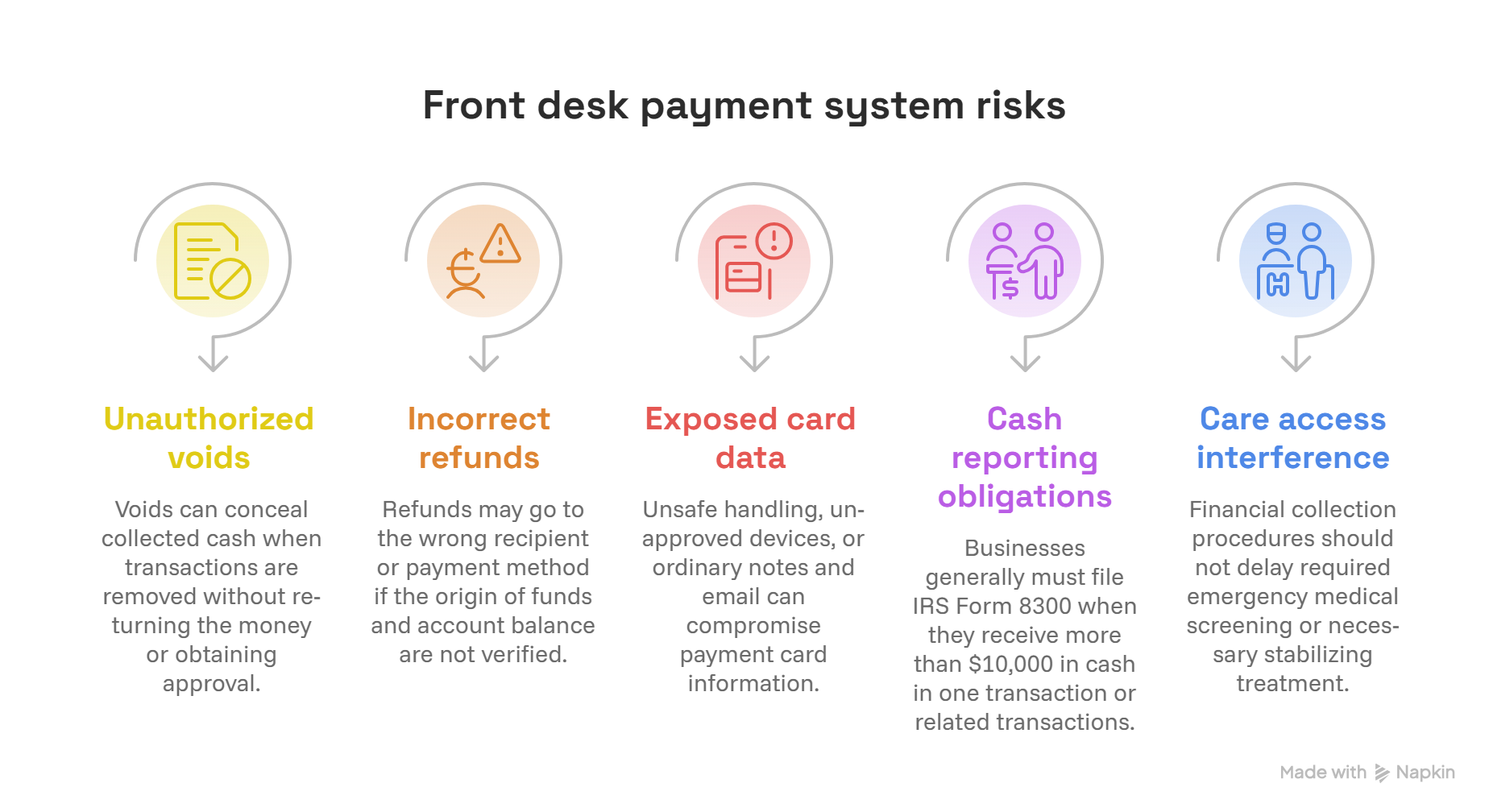
Risk 1: Unauthorized voids conceal collected cash
An employee accepts a $60 cash payment and provides a receipt.
Later, the employee voids the transaction in the practice management system without returning the money or obtaining approval.
If the system simply removes the transaction from reported collections, the corresponding cash can become difficult to trace.
The practice should preserve the original payment record, void timestamp, user identifier, reason, and approval.
A void should follow a documented process and should never erase the audit history of the original transaction.
A useful exception report identifies high-risk patterns, including repeated voids near closing time, frequent reversals by individual users, and corrections lacking supporting documentation.
Strong healthcare compliance monitoring, role-based workflow permissions, professional administrative standards, and system audit controls help detect unauthorized activity.
Recommended control: Require appropriate independent authorization for high-risk voids and review transaction reversals regularly.
Risk 2: Refunds are issued to an incorrect person or payment method
A patient requests a refund after receiving an insurance adjustment.
The account contains a credit, but the original payment was made by a different responsible party or may have come from another payer.
Issuing the refund immediately could send money to the wrong recipient.
The refund process should verify the origin of the funds, the final patient account balance, legal or contractual obligations, and the appropriate payment destination.
Card refunds should generally follow the payment processor's approved original-tender refund workflow, subject to valid exceptions and applicable rules.
A robust system also prevents duplicate refunds arising when different staff members respond to the same request.
Relevant safeguards include confidential healthcare communication, secure patient messaging, automated approval workflows, and written financial documentation.
Recommended control: Require separate refund verification, authorized approval, and confirmation that the patient's account reflects the completed transaction.
Risk 3: Payment card information is exposed through unsafe handling
Medical offices accepting credit or debit cards must protect payment account data in accordance with applicable payment card requirements.
PCI DSS provides security requirements for environments that store, process, or transmit relevant payment account data, as well as systems that can affect that environment.
A receptionist writing down complete card numbers or sensitive authentication information for later processing can introduce serious security risks.
Similarly, using an unapproved payment device, storing payment information in ordinary notes, or sending card details through email may compromise security.
The organization should use approved payment terminals, maintain appropriate device controls, and follow its processor's security requirements.
Sensitive card information should remain outside general clinical documentation workflows.
These practices connect healthcare cybersecurity training, secure communication systems, medical administration troubleshooting, and compliance software oversight.
Recommended control: Inspect payment terminals regularly, limit access to authorized users, and establish a documented response procedure for suspected compromise.
Risk 4: Large cash transactions trigger reporting obligations
In the United States, businesses generally must file IRS Form 8300 when they receive more than $10,000 in cash in one transaction or related transactions.
The general filing deadline is 15 days after the reportable cash payment is received.
For example, a medical facility receiving $6,000 in qualifying cash toward a service and an additional $5,000 in cash as part of the same transaction must evaluate the combined $11,000 payment for Form 8300 reporting.
The rules also address related transactions, multiple payments, record retention, and required customer statements.
The legal definition of cash for this purpose includes U.S. or foreign currency and, in specified circumstances, certain monetary instruments.
Employees should escalate potentially reportable transactions to the organization's financial or compliance personnel. Practices should avoid structuring or encouraging payments to circumvent reporting requirements.
A cashier's role is to record the payment accurately and follow approved procedures. The compliance function determines the reporting treatment.
Understanding healthcare compliance procedures, financial documentation requirements, professional communication standards, and secure administrative workflows supports appropriate handling.
Risk 5: Payment collection interferes with patient access to care
Financial collection procedures should be consistent with applicable patient rights, emergency care obligations, payer requirements, and organizational policies.
For example, hospitals covered by EMTALA must ensure that routine registration or payment inquiries do not delay a required emergency medical screening examination or necessary stabilizing treatment.
Staff should understand which financial conversations are appropriate before service, which may occur afterward, and when clinical needs require immediate escalation.
Careful front desk communication, patient rapport-building techniques, assertive medical administration skills, and team coordination procedures help employees manage difficult situations appropriately.
Recommended control: Include financial collection boundaries in staff training and establish a direct escalation route for patients requiring urgent clinical assessment.
5. Building a Front Desk Cash Handling System That Is Accurate and Audit-Ready
A medical practice can improve financial accountability by standardizing daily procedures, restricting high-risk permissions, training employees, and reviewing transaction exceptions before they become recurring problems.
The following implementation framework can be adapted to small clinics, specialty practices, and larger healthcare organizations.
Step 1: Establish written cash handling responsibilities
Start with a responsibility matrix covering payment collection, posting, refunds, cash custody, deposit preparation, reconciliation, and financial review.
Each activity should have an accountable employee, appropriate permissions, a backup arrangement, and a documented escalation process.
Where possible, separate employees who receive funds from those who approve adjustments and reconcile bank activity.
Small offices may need compensating controls, such as a manager independently reviewing daily register activity and comparing deposits with bank records.
Clear responsibilities reduce the possibility that a single employee can create an unauthorized transaction and conceal it through an accounting adjustment.
Relevant training includes front desk professionalism, team communication procedures, healthcare compliance systems, and workflow authorization controls.
Step 2: Implement a daily reconciliation checklist
Every closing procedure should capture the opening float, total cash payments, authorized cash refunds, cash drops, ending drawer count, and any identified variance.
Electronic payments should have separate totals for approved transactions, completed settlements, refunds, and relevant processing adjustments.
The checklist should also confirm that receipts correspond to patient account postings and that financial exceptions have identifiable owners.
A practice should document the outcome of each discrepancy, even when the difference is small.
For example, a recurring $2 shortage can indicate a systematic change-making problem or weakness in the transaction process.
A consistent administrative documentation system, healthcare automation workflow, technical reconciliation process, and team handoff procedure makes unresolved differences easier to investigate.
Step 3: Build a financial exception dashboard
A useful cash handling dashboard should measure transaction quality alongside the dollar amounts collected.
Prioritize the following indicators:
Cash variance rate: Shifts or drawers with unexplained overages or shortages divided by shifts or drawers reviewed.
Payment posting accuracy: Audited payments correctly assigned to the intended patient accounts divided by payments assessed.
Refund exception rate: Refunds requiring additional correction or investigation divided by refunds reviewed.
Unapplied cash aging: Number and value of payments remaining unresolved across defined time intervals.
Deposit reconciliation completion: Deposits reconciled to relevant collection and bank records within the established timeframe.
Card settlement exception rate: Card transactions or batches requiring investigation under the organization's defined rules.
Unauthorized adjustment incidents: Confirmed transactions occurring without required approval.
For example, if a practice audits 500 patient payment postings and identifies 12 incorrectly allocated payments, its posting accuracy is:
488 ÷ 500 × 100 = 97.6%.
The remaining 2.4% should be categorized by cause, such as incorrect account selection, duplicate posting, integration failure, or manual entry error.
These findings can guide improvements to patient registration systems, practice management integrations, administrative automation, and employee communication protocols.
Step 4: Train employees using realistic payment scenarios
Employees should demonstrate practical competence before handling patient funds without direct supervision.
Useful training scenarios include calculating change, processing split payments, identifying incorrect patient accounts, responding to card transaction failures, and routing refund requests.
Training should also cover suspected fraud, payment card security, patient privacy, and appropriate financial conversations.
For example, a patient disputing a deductible estimate should receive an explanation of the available information and the correct escalation route.
Staff should avoid making unsupported promises about final insurance responsibility or changing account balances to resolve a disagreement.
These skills develop through patient interaction scripts, verbal communication training, assertiveness in medical administration, confidential communication practices, and professional front desk etiquette.
Step 5: Conduct monthly independent financial reviews
Daily reconciliation identifies immediate discrepancies, while monthly reviews reveal patterns that individual shifts may conceal.
A monthly audit should sample patient receipts, cash counts, deposit records, card settlements, refunds, account adjustments, and unresolved credits.
Compare transaction frequency and exception patterns across locations, shifts, and authorized users where appropriate.
For example, suppose an office reduces its unexplained cash variance incidents from ten per month to four after introducing individual drawer assignments and independent closing reviews.
This represents a 60% reduction in incidents.
The organization should confirm that the measurement method remained consistent and review whether the improvement continues in subsequent months.
Each audit should produce a documented finding, required correction, assigned owner, target completion date, and follow-up verification.
Combining healthcare compliance reporting, secure financial systems, workflow automation, and written administrative documentation supports a reliable audit process.
6. Frequently Asked Questions About Front Desk Cash Handling
-
Front desk staff commonly collect patient payments, verify the amount due, issue receipts, post transactions, secure funds, and prepare shift closing records.
Each responsibility should follow written organizational procedures with appropriate authorization and audit controls.
Employees should understand how to distinguish cash collection from patient account posting and bank reconciliation.
Training in medical front desk etiquette, written administrative communication, healthcare compliance software, and professional medical administration helps establish consistent practices.
-
Begin with the opening cash float, add recorded cash receipts, and subtract authorized cash movements such as documented cash refunds and cash drops.
Compare the expected cash remaining with the physical amount counted.
For example, an opening float of $100 plus $250 in cash receipts and a $20 approved cash refund produces an expected closing balance of $330.
If the drawer contains $325, the shortage is $5.
Document the variance and investigate it under the organization's approved process.
Supporting procedures include administrative recordkeeping, financial compliance monitoring, and team communication protocols.
-
A void generally cancels a transaction before final processing or settlement, depending on the payment system.
A refund returns funds associated with a previously completed payment.
The appropriate process depends on transaction status, payment method, processor capabilities, and organizational policies.
Both activities should preserve the original transaction record, authorization information, and reason for correction.
Medical practices should restrict access to these functions and monitor unusual activity.
Understanding healthcare cybersecurity controls, workflow access management, patient communication procedures, and compliance reporting supports appropriate handling.
-
Common causes include incorrect patient selection, posting to the wrong encounter, delayed system synchronization, duplicated charges, unapplied payments, or incomplete insurance adjudication.
Administrators should verify the receipt reference, patient identifier, payment method, and ledger posting.
A physical cash drawer can balance even when a payment was applied to the wrong account.
Corrections should preserve the original transaction history.
Useful supporting knowledge includes electronic record management, patient registration workflows, technical troubleshooting, and secure patient communication.
-
PCI DSS applies to relevant payment account data environments and entities involved in card payment processing, with specific requirements depending on the organization's role, systems, and applicable validation obligations.
Medical practices accepting card payments should work with their payment processor or acquiring institution to determine the appropriate compliance requirements.
Staff should use approved terminals and follow secure handling procedures for payment account information.
Training in healthcare cybersecurity terminology, confidential communication, administrative troubleshooting, and compliance controls helps reduce exposure.
-
The receptionist should confirm the service type, available benefit information, and the amount recorded as due.
The employee should explain the verified information respectfully and identify any uncertainty requiring billing or payer review.
Insurance cost-sharing requirements can vary according to deductible status, network arrangements, service category, and plan terms.
A disputed estimate should be distinguished from an adjudicated patient balance.
Consistent patient communication scripts, verbal communication skills, rapport-building techniques, and professional front desk practices help manage these situations.
