

A single incorrect patient identifier can trigger duplicate records, delayed referrals, rejected claims, and clinical documentation errors that take hours to untangle. Medical administrators prevent these problems by understanding how healthcare information is collected, validated, exchanged, secured, and corrected.
This interactive guide explains essential healthcare data management terminology through real administrative scenarios, a 30-term reference dictionary, and actionable troubleshooting frameworks. You'll learn how to recognize data integrity failures, investigate EHR integration problems, strengthen patient information security, and measure improvements that reduce rework across medical practices.
1. Understanding Healthcare Data Management: The Core Principles Behind Accurate Medical Records
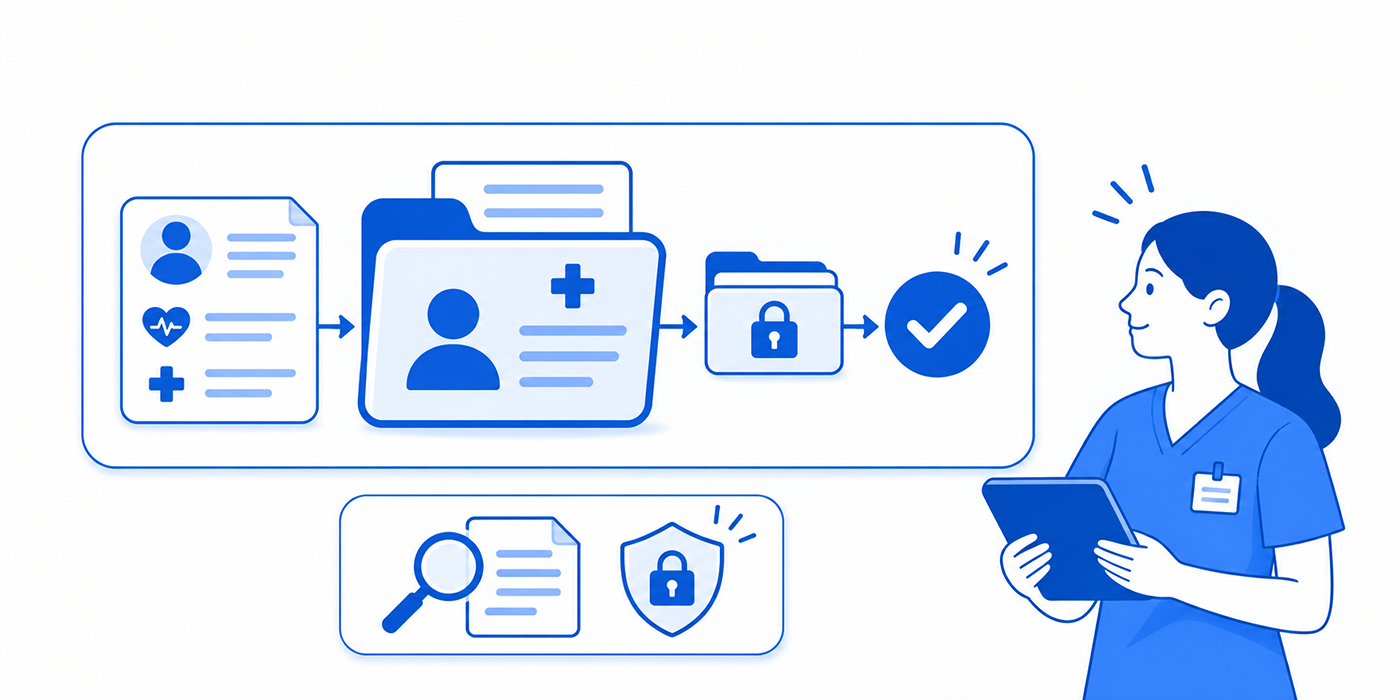
Healthcare data management covers the processes used to collect, classify, validate, store, retrieve, exchange, update, and protect information throughout its lifecycle.
For medical administrators, these processes begin during patient check-in and extend into appointment scheduling integrations, clinical documentation, and healthcare workflow automation.
The greatest operational risk comes from information that appears correct within one system but becomes inaccurate when another department uses it.
A registration specialist might update a patient's insurance information successfully, while the billing application continues displaying the previous policy. Both systems remain operational, yet the inconsistency can delay authorization or create unnecessary claim rework.
The six dimensions of healthcare data quality
Administrators should evaluate records across six dimensions:
Accuracy: Information reflects a verified source. An insurance member ID must match the appropriate coverage record.
Completeness: Required information exists for the intended workflow. A referral may need supporting documentation before authorization processing.
Consistency: Related systems contain compatible information. A patient's appointment status should agree across integrated scheduling applications.
Timeliness: Information is sufficiently current for its intended use. Eligibility information may require verification close to the service date.
Validity: Information conforms to defined business rules, accepted formats, and coding requirements.
Uniqueness: Patient identities and other designated records are represented without unintended duplication.
These dimensions support reliable cloud-based electronic medical records, appointment reminder software, secure healthcare messaging, and healthcare data automation.
Three categories of data that administrators must distinguish
Master data identifies important entities such as patients, healthcare professionals, locations, and departments. Patient demographic information is a common example.
Transactional data records activities, including appointments, encounters, claim submissions, payments, and eligibility inquiries.
Reference data provides standardized values used to classify information, including appointment categories, departmental codes, and controlled terminology.
Confusing these categories can cause serious problems. Updating a patient's current insurance policy must preserve the correct relationship between the policy's effective dates and historical encounters. Replacing earlier coverage information indiscriminately may interfere with previously submitted claims.
Likewise, a patient surname change should preserve the connection between historical documentation and the verified patient identity.
Understanding this distinction strengthens written medical communication, team information handoffs, medical administration troubleshooting, and professional record handling.
| # | Term | Practical Definition | Warning Sign | Recommended First Action |
|---|---|---|---|---|
| 1 | Master Patient Index (MPI) | Index supporting consistent patient identification across healthcare records. | One patient appears under several identities. | Verify identifiers through the approved patient registration workflow. |
| 2 | Medical Record Number (MRN) | Identifier assigned to a patient record within an organization or system. | Similar identifiers cause record-selection errors. | Verify identity using additional approved patient identifiers. |
| 3 | Encounter Identifier | Identifier associated with a specific healthcare visit or interaction. | Documents appear under the wrong visit. | Check patient identity, encounter date, and scheduling information. |
| 4 | Duplicate Patient Record | Two or more unintended records represent one individual. | Clinical history becomes fragmented. | Flag the suspected duplicate for authorized identity review. |
| 5 | Patient Overlay | Information belonging to one patient is entered into another patient's record. | Unexpected diagnoses, medications, or results appear. | Escalate immediately using patient safety procedures. |
| 6 | Patient Matching | Process of identifying records that belong to the same person. | Similar names produce uncertain matches. | Compare multiple verified demographic attributes. |
| 7 | Source of Truth | Designated authoritative source for a specific data element. | Different applications show conflicting values. | Check approved system ownership rules. |
| 8 | Data Governance | Policies defining information ownership, quality, security, and accountability. | Employees disagree about correction authority. | Consult the data governance and professional responsibility framework. |
| 9 | Data Stewardship | Operational responsibility for maintaining defined data standards. | Recurring errors remain unresolved. | Assign a responsible data steward and escalation owner. |
| 10 | Data Dictionary | Catalog documenting field definitions, formats, meanings, and accepted values. | Departments interpret fields differently. | Review the approved field definition before updating records. |
| 11 | Data Validation | Checking whether information satisfies established requirements. | Invalid dates or formats pass through registration. | Apply authorized validation rules. |
| 12 | Required Field | Information that must be provided for a specified workflow. | Incomplete forms prevent processing. | Confirm the requirement and obtain information through approved patient communication. |
| 13 | Data Normalization | Standardizing data representation according to defined rules. | Different formats disrupt matching or reporting. | Apply approved formats without changing verified meaning. |
| 14 | Field Mapping | Connecting data fields between source and destination applications. | Referral priority appears in the wrong field. | Request an integration mapping review. |
| 15 | Structured Data | Information organized in defined fields or coded formats. | Required values appear only in free-text notes. | Determine whether authorized structured entry is required. |
| 16 | Unstructured Data | Information contained in narrative text or other loosely organized formats. | Important details become difficult to retrieve. | Preserve meaning through approved documentation procedures. |
| 17 | Data Provenance | Evidence describing information origin, authorship, and relevant history. | A clinical statement has unclear authorship. | Review documentation sources and dictation records. |
| 18 | Data Lineage | Traceable path of information through systems and transformations. | One incorrect value spreads across applications. | Trace its origin, transmission, and modification history. |
| 19 | Interface Engine | Software that routes, transforms, or monitors messages between systems. | Messages remain rejected or unprocessed. | Provide transaction details to interface support. |
| 20 | HL7 Version 2 | Healthcare messaging standard used for exchanges such as admissions and results. | Expected clinical messages do not arrive. | Report message type, timestamp, and identifiers. |
| 21 | FHIR | HL7 standard using defined resources to support healthcare information exchange. | Connected applications omit expected records. | Identify affected resources and integration behavior. |
| 22 | Application Programming Interface (API) | Defined software interface for exchanging information or requesting functions. | Connected tools display outdated data. | Report the request context and affected application. |
| 23 | EDI 270/271 | Standard healthcare eligibility inquiry and response transactions. | Eligibility checks return errors or unexpected information. | Verify submitted payer and patient identifiers. |
| 24 | EDI 837 | Standard transaction for submitting healthcare claims. | Claims fail validation or processing. | Review submission status and billing workflow exceptions. |
| 25 | EDI 835 | Electronic healthcare payment and remittance advice transaction. | Payment details do not reconcile with claims. | Match remittance identifiers with the relevant claim records. |
| 26 | Exception Queue | Worklist holding records requiring investigation or corrective action. | Unresolved errors accumulate over multiple days. | Prioritize by risk, assign ownership, and track closure. |
| 27 | Data Reconciliation | Comparing records and resolving justified differences between information sources. | Appointment counts differ between applications. | Compare identifiers, timestamps, and processing logs. |
| 28 | Synchronization Latency | Delay between a source update and its availability downstream. | Recent changes have not appeared elsewhere. | Check scheduled refresh intervals before reentry. |
| 29 | Audit Trail | Recorded evidence of relevant system activity and information changes. | Record modifications have unclear origins. | Request authorized activity review. |
| 30 | Role-Based Access Control (RBAC) | Permissions assigned according to defined organizational roles. | Employees can view unnecessary sensitive information. | Request a permission review. |
| 31 | Encryption | Protecting information through cryptographic transformation. | Sensitive data are exported through unapproved channels. | Follow required secure transfer procedures. |
| 32 | Record Retention Schedule | Rules defining required preservation and authorized disposal periods. | Records are deleted before applicable obligations expire. | Check legal holds, policy requirements, and retention authorization. |
2. Patient Data Integrity and Record Validation: How to Prevent Costly Registration Errors
Patient information errors can continue through multiple departments long after registration is complete. A wrong date of birth may interfere with insurance verification, while a misidentified record can affect medication reconciliation, laboratory results, and clinical decision-making.
Healthcare administrators should distinguish three identity problems before attempting correction.
Duplicate records, patient overlays, and matching failures
Duplicate records occur when multiple records unintentionally represent the same person. This can fragment information across different charts.
Patient overlays occur when one individual's information is entered into another person's chart. This can introduce misleading clinical information and create patient safety concerns.
Patient matching failures involve incorrect decisions about whether records belong to the same person. False matches can combine unrelated patient information, while missed matches can leave one patient's history fragmented.
Consider a registration employee searching for a patient named Maria Rodriguez. The system displays three similar names.
Selecting a record based only on the name creates avoidable risk. The employee should verify additional approved identifiers, including date of birth and other verified demographic information.
In virtual patient check-in, medical front-desk operations, patient interaction scripts, and appointment scheduling workflows, identity verification should take place before creating or changing patient records.
The six-step patient data correction protocol
Step 1: Confirm patient and encounter identity. Verify the individual using approved identifiers. Check the relevant encounter before making any changes.
Step 2: Determine the authoritative source. Identify which verified document, application, payer response, or approved patient statement governs the disputed information.
Step 3: Classify the discrepancy. Separate missing information, invalid formatting, outdated values, conflicting records, suspected duplicates, and possible overlays.
Step 4: Assess downstream exposure. Determine whether the information has influenced appointments, referrals, clinical documentation, patient messages, or claims.
Step 5: Follow authorized correction procedures. Apply appropriate role permissions. Patient identity merges and clinical record amendments may require specialized approval.
Step 6: Verify resolution. Confirm that the corrected information appears in appropriate downstream systems and that the original exception has been properly closed.
These procedures depend on accurate written communication, confidential information exchange, team coordination, and medical administration troubleshooting.
Why correcting information can create additional errors
Suppose an administrator notices that a patient's current insurance information differs from the policy attached to a previous appointment.
Replacing historical insurance details with the current policy may produce inaccurate billing information for services performed before the coverage change.
The correction must preserve the relationship between coverage dates, encounters, and claims.
The same principle applies to clinical documentation. When a patient's reported medication differs from a signed note, authorized clinical personnel must determine the appropriate documentation response.
Administrators supporting medical transcription, medical dictation workflows, professional record management, and secure clinical communication should preserve the original record's provenance and follow approved amendment procedures.
Practical example: A practice processes 2,500 patient registrations and confirms 20 registration errors during the review period.
The observed error rate is 8 errors per 1,000 registrations.
Administrators should classify those 20 errors by source, such as demographic entry, insurance identification, duplicate creation, or appointment association. This classification reveals which workflow requires correction.
Preventing errors at their point of origin
Effective validation should catch questionable information before it spreads into additional systems.
For example, software can flag potentially duplicate identities, invalid dates, missing required identifiers, and unsupported appointment categories.
However, rigid validation rules may accidentally exclude legitimate patients. International addresses, compound surnames, legal name changes, and incomplete historical records require appropriate exception pathways.
Effective patient registration training, healthcare automation controls, administrative conflict management, and EHR troubleshooting practices help staff correct exceptions without creating inaccurate placeholder values.
3. EHR Data Integration, Interoperability, and Information Exchange: Troubleshooting Broken Workflows
Medical practices rely on multiple applications to manage scheduling, documentation, insurance eligibility, referrals, laboratory information, and billing.
These applications may exchange information through APIs, interfaces, scheduled imports, and standardized healthcare transactions.
When information becomes unavailable, administrators need to distinguish transmission failures, mapping errors, processing rejections, and display problems.
Each requires a different corrective response.
Understanding HL7, FHIR, APIs, and interface engines
HL7 Version 2 supports standardized healthcare messaging between systems. It is commonly associated with exchanges such as patient admissions, orders, and results.
FHIR, or Fast Healthcare Interoperability Resources, provides standardized resources and technical approaches for exchanging healthcare information.
APIs define how applications request or exchange information and use supported software functions.
Interface engines can route, transform, and monitor messages moving between healthcare applications.
These technologies influence cloud-based EMR integration, patient scheduling connections, healthcare workflow automation, and technical troubleshooting.
Administrators benefit from knowing what each term means because successful transmission alone does not establish that data arrived correctly.
A real-world mapping failure that changes appointment priority
Imagine a referral application sends the following information:
Patient identifier: 008521
Specialty: Cardiology
Appointment priority: Urgent
Requested service date: December 15
Referral status: Approved
The receiving scheduling application imports the record but incorrectly maps the urgency field into a general comments section.
As a result, staff reviewing the appointment queue may see a routine referral even though the originating system specifies urgent priority.
A proper investigation should identify the source field, transmitted value, destination field, applicable transformation rule, and resulting display.
This information helps teams distinguish a scheduling workflow defect from a communication failure or an EHR integration problem.
Affected referrals should be escalated according to clinical urgency rather than remaining in a routine technical support queue.
Insurance eligibility versus claim payment data
Medical administrators should understand the purpose of common Electronic Data Interchange transactions.
EDI 270/271: The 270 communicates an eligibility inquiry, while the 271 provides the corresponding response.
EDI 837: Used for submitting healthcare claims.
EDI 835: Used for electronic payment or remittance advice.
These transactions provide distinct pieces of administrative information.
An eligibility response showing active coverage does not guarantee payment for a future claim. Benefits, exclusions, authorization requirements, medical necessity, and applicable payer rules can affect the final determination.
This distinction matters in patient financial communication, virtual check-in procedures, front-desk administrative operations, and billing workflow automation.
Seven questions to ask when patient information disappears
Before submitting a technical support ticket, establish:
Identity: Are employees viewing the correct patient and encounter?
Origin: Which application originally created or updated the information?
Transmission: Was the information successfully transmitted?
Mapping: Did the destination application assign the information to the intended fields?
Validation: Did the receiving system reject the record because of a defined requirement?
Visibility: Are permissions, filters, encounter status, or review requirements affecting display?
Timing: Has the expected synchronization period elapsed?
These questions reduce unnecessary reentry, duplicated troubleshooting, and incomplete support requests.
A useful technical ticket includes the affected record identifier, source and destination systems, observed behavior, expected behavior, timestamps, and business impact. Patient information should be shared only through approved channels.
Strong written incident reporting, secure communication, administrative assertiveness, and technical support coordination help resolve problems without exposing confidential data.
4. Healthcare Data Governance, HIPAA Compliance, and Information Security: Protecting Records Throughout Their Lifecycle
Healthcare data governance establishes accountability for information quality, authorized access, record corrections, and retention.
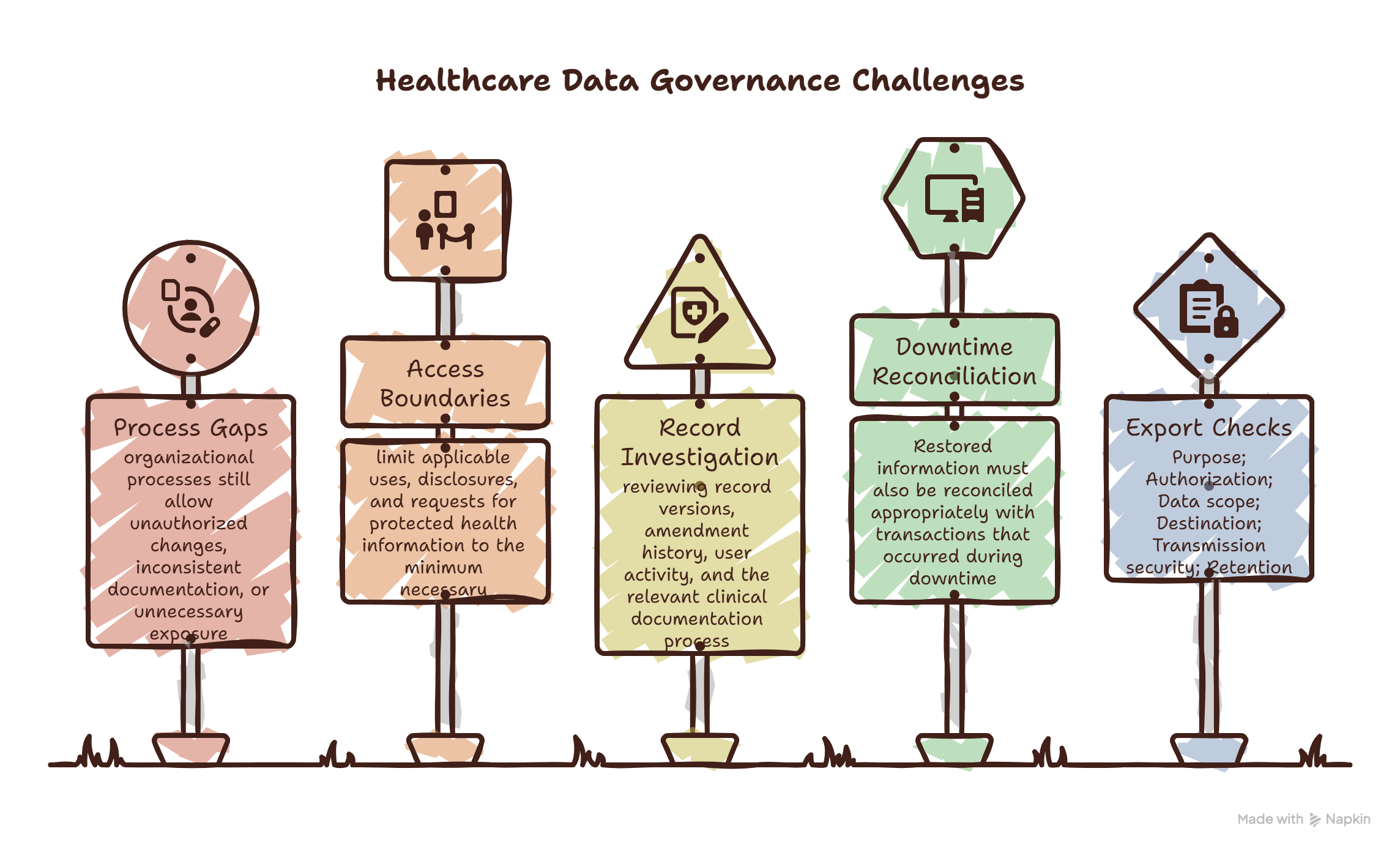
A system may store information correctly while organizational processes still allow unauthorized changes, inconsistent documentation, or unnecessary exposure of sensitive records.
Medical administrators should understand the controls that govern these risks.
Data ownership versus data stewardship
Data ownership identifies the organizational function accountable for decisions concerning particular information.
Data stewardship involves maintaining data definitions, monitoring quality, coordinating corrections, and enforcing established standards.
Consider a disagreement about a patient's allergy information.
A registration employee may recognize the discrepancy, but clinical personnel must assess and resolve the clinical content according to their authority and organizational procedures.
Similarly, demographic corrections may fall within registration responsibilities, while technical identity merges require trained health information management personnel.
Clearly defined ownership supports professional medical administration, clinical team communication, secure healthcare messaging, and healthcare compliance workflows.
A practical governance register should identify the data category, accountable department, authorized editors, authoritative source, escalation owner, and required correction evidence.
HIPAA minimum necessary and role-based access
The HIPAA Privacy Rule generally requires covered entities to make reasonable efforts to limit applicable uses, disclosures, and requests for protected health information to the minimum necessary for the intended purpose.
The standard includes important exceptions, including disclosures to or requests by healthcare providers for treatment purposes, disclosures to the individual, and certain other permitted circumstances.
Organizations should translate these requirements into appropriate access policies and workforce responsibilities.
For example, a scheduling employee may require access to appointment details and demographic information, while broader clinical-record permissions depend on legitimate assigned duties.
Role-based access control helps organizations align system permissions with those responsibilities.
Effective healthcare cybersecurity safeguards, confidential communication procedures, secure messaging policies, and healthcare compliance systems help maintain those boundaries.
Administrators should report unusual permissions rather than attempting to resolve access-control problems through shared accounts or unauthorized workarounds.
Audit trails and record provenance
An audit trail records relevant system activity, potentially including access events, changes, timestamps, and user identifiers.
Provenance provides information about the origin and history of data.
These concepts overlap operationally but answer different questions.
An audit trail may help determine when a demographic field changed and which account performed the action. Provenance helps establish where particular information originated and how it was created or maintained.
Consider a signed medical note that appears to have been modified after an encounter.
An authorized investigation may require reviewing record versions, amendment history, user activity, and the relevant clinical documentation process.
The investigation should preserve appropriate evidence while limiting access to authorized personnel.
Training in written medical documentation, medical transcription procedures, medical dictation accuracy, and professional record handling can help employees recognize questionable changes.
Retention schedules, secure disposal, and downtime recovery
Healthcare records may have different retention requirements depending on jurisdiction, record category, organizational obligations, and applicable legal holds.
Administrators must distinguish three related responsibilities.
Retention: Maintaining required information for the appropriate period.
Secure disposition: Disposing of records through authorized procedures after applicable obligations have been satisfied.
Backup and recovery: Preserving recoverable copies and restoring information or services following disruption.
An ordinary backup is not a substitute for a governed record retention program. Restored information must also be reconciled appropriately with transactions that occurred during downtime.
For example, appointments rescheduled through an approved paper-based procedure during an outage may need reconciliation after the scheduling system becomes available.
Failing to reconcile them can create duplicate appointments, missed notifications, and inaccurate visit statuses.
Administrators supporting appointment reminder systems, cloud-based EMR operations, administrative technology troubleshooting, and workflow automation should understand their role in downtime reconciliation.
A practical security checklist for administrative data exports
Before sharing patient information through an approved report or export, verify:
Purpose: The recipient has an appropriate reason to receive the information.
Authorization: The disclosure or access is permitted under applicable requirements.
Data scope: Included fields are appropriate for the purpose and relevant rules.
Destination: The information is being delivered to the correct recipient or system.
Transmission security: The organization-approved transfer method is being used.
Retention: Copies are handled according to applicable storage and disposal procedures.
These checks are particularly important when exporting patient lists for appointment reminders, coordinating referral communications, preparing written administrative correspondence, or maintaining compliance reports.
An effective incident record should identify the affected process, responsible team, incident classification, corrective action, and verification of resolution.
5. Building a Reliable Healthcare Data Management System: A 30-Day Action Plan and Performance Metrics
Healthcare organizations can improve data management by addressing recurring errors at their point of origin, assigning responsibility for exceptions, and measuring whether corrective actions produce lasting results.
The following implementation plan focuses on practical improvements that medical administrators can coordinate using existing systems.
Days 1–7: Map critical data and identify recurring failures
Start by identifying the information most frequently responsible for administrative delays.
Prioritize patient identifiers, insurance details, referral information, appointment statuses, and document-to-encounter associations.
For each data category, document the authoritative source, responsible department, downstream applications, validation requirements, and correction procedures.
Review error reports from patient scheduling integrations, virtual check-in systems, medical documentation processes, and administrative technology support.
Focus on defects that repeatedly require staff to contact patients, reopen records, resubmit transactions, or investigate conflicting information.
Expected deliverable: A prioritized inventory identifying the five most disruptive data quality problems, their sources, and accountable owners.
Days 8–14: Establish validation and exception-handling procedures
Develop checks for the highest-risk fields and define clear exception pathways.
For demographic information, this might include required identifier verification, accepted date formats, possible duplicate alerts, and procedures for resolving conflicting records.
For insurance information, establish rules for checking policy identifiers, coverage dates, and the relationship between eligibility responses and appointment dates.
Each exception should include a case identifier, assigned owner, risk category, discovery timestamp, target resolution time, and closure evidence.
Use healthcare workflow automation to support appropriate alerts, written administrative communication to document actions, team coordination procedures to establish ownership, and secure messaging to protect information exchanged during investigations.
Create separate escalation pathways for patient safety concerns, privacy incidents, and routine administrative corrections.
Expected deliverable: An approved validation checklist and exception register with clearly assigned responsibilities.
Days 15–21: Test data flows using controlled scenarios
Use fictional patient records in an approved test environment to examine the behavior of integrated systems.
Test five scenarios.
Scenario A: Possible duplicate registration. Enter a fictional patient resembling an existing test identity and determine whether the workflow produces an appropriate matching warning.
Scenario B: Incorrect referral mapping. Send a test referral containing a defined specialty, urgency level, and requested date. Confirm that all fields reach their intended destinations.
Scenario C: Insurance policy changes. Update fictional coverage information and verify that downstream systems preserve the correct effective dates.
Scenario D: Restricted record access. Confirm that a designated test account cannot access information outside its approved permissions.
Scenario E: Interrupted synchronization. Simulate an approved integration failure and evaluate whether the resulting exception becomes visible to the responsible support team.
These exercises connect cloud-based EHR integration, healthcare cybersecurity testing, patient scheduling workflows, and medical administration troubleshooting.
Each test should record expected behavior, actual behavior, identified defects, responsible personnel, and successful retest evidence.
Expected deliverable: A workflow validation report documenting confirmed control gaps and corrective actions.
Days 22–30: Introduce measurable data quality monitoring
The final stage involves selecting performance metrics that reveal whether administrative records are becoming more reliable.
Seven measures are particularly useful.
1. Registration error rate
Calculation: Confirmed registration errors ÷ completed registrations × 1,000.
This measures the frequency of verified registration defects. Classifying errors by demographic, identity, insurance, and encounter-association categories makes the metric more actionable.
2. Duplicate detection rate
Calculation: Confirmed duplicate records discovered during the period ÷ registrations completed during the period × 1,000.
This measures detected duplicate burden relative to registration volume. When discoveries include historical records, interpret the metric as a detection measure rather than the actual rate at which new duplicates are created.
3. Exception resolution time
Calculation: Median elapsed time from exception detection to verified closure.
The median reduces distortion from a small number of unusually old cases. Review patient-safety-critical exceptions separately from routine administrative issues.
4. First-pass validation rate
Calculation: Records passing defined validation checks initially ÷ records evaluated × 100.
This indicates how consistently information meets specified requirements at entry. Document which checks are included so performance remains comparable across reporting periods.
5. Integration failure rate
Calculation: Failed transmission attempts ÷ total attempted transmissions × 100.
Separate connection failures, rejected messages, and incorrectly mapped records. These errors require different technical responses.
6. Overdue exception rate
Calculation: Open exceptions past their assigned resolution targets ÷ all open exceptions × 100.
This reveals unresolved backlog pressure and helps managers determine whether escalation or staffing adjustments are necessary.
7. Correction recurrence rate
Calculation: Confirmed recurring defects ÷ resolved defects evaluated for recurrence × 100.
Define a consistent observation period and recurrence criteria. A repeat occurrence involving the same field and cause can indicate that the original corrective action failed to address the underlying problem.
These metrics can guide improvements in healthcare automation workflows, cloud-based medical records, scheduling systems, and compliance monitoring processes.
Calculating the financial impact of preventable data errors
Suppose a medical practice processes 4,000 patient registrations monthly.
If 2% require additional correction work averaging 12 minutes per case, the practice handles 80 corrections and spends approximately 16 staff hours resolving them.
At an illustrative loaded labor cost of $25 per hour, that represents $400 monthly in direct correction labor.
If improved validation reduces the observed error rate to 0.75%, the practice would experience approximately 30 correction cases monthly under otherwise unchanged conditions.
The reduction represents 50 avoided correction cases and approximately 10 labor hours saved each month.
This example excludes potential downstream costs associated with delayed referrals, rejected claims, duplicated communications, and clinical disruption.
When assessing healthcare workflow automation, appointment scheduling technology, administrative staff training, and medical technology improvements, calculate costs using actual labor time, validated error counts, and documented operational consequences.
The strongest data management programs demonstrate improvement through fewer recurring defects, faster verified corrections, more reliable integrations, and appropriately protected patient information.
6. FAQs: Healthcare Data Management Terms, Patient Record Accuracy, and Administrative Best Practices
-
Data management covers the operational activities involved in collecting, organizing, maintaining, exchanging, validating, and protecting information.
Data governance establishes the policies, ownership, accountability, decision rights, and oversight guiding those activities.
For example, correcting an invalid demographic field is a data management activity. Establishing which employees may correct that field, which evidence they must use, and how their changes are audited belongs to data governance.
Organizations need both functions to maintain reliable cloud-based medical records and compliance monitoring procedures.
-
Patient overlays are particularly concerning because information belonging to one individual becomes associated with another person's record.
This can affect medication histories, allergies, laboratory information, and clinical decisions.
Suspected overlays require prompt escalation through approved identity-management and clinical safety procedures.
Accurate patient registration and appropriate clinical team communication can help reduce these risks.
-
Begin by identifying the data element, patient, encounter, and relevant timestamps.
Determine which system is authoritative for the disputed information. Check whether recent changes have synchronized and whether transformation or mapping rules explain the difference.
Document the discrepancy and route corrections to authorized personnel.
A standardized technical troubleshooting process improves consistency, while secure messaging procedures help protect patient information during investigation.
-
A medical record number generally identifies a patient's record within a particular organization or system.
An encounter identifier represents a specific visit or healthcare interaction.
One patient may have multiple encounters associated with an established medical record.
Administrators handling appointment scheduling integrations and medical documentation workflows should verify both identifiers when investigating misfiled documents.
-
Permission depends on the employee's authorized responsibilities, organizational policy, applicable requirements, and the type of information involved.
An administrator may be permitted to correct designated demographic or administrative fields. Clinical content requiring professional interpretation or an authorized amendment should be handled through the appropriate clinical process.
When encountering questionable documentation, employees should preserve the issue and communicate it through approved channels.
Effective medical dictation review and professional communication support these boundaries.
-
Data validation tests whether information satisfies defined requirements, such as acceptable formats, required values, or permitted codes.
Data reconciliation compares information across records or systems to identify and resolve differences.
A date field containing an impossible calendar date represents a validation problem. Two systems showing different appointment dates represent a reconciliation problem.
Healthcare organizations can use workflow automation and patient scheduling controls to support both processes.
