

Is Virtual Scribing Good Clinical Experience for Premed? Reddit Debate, Med-School Context & How to Strengthen It
Virtual medical scribing offers premeds physician exposure, flexible scheduling, and experience with real clinical documentation. Yet a difficult admissions question remains: will medical schools value 800 hours of remote charting as highly as 800 hours spent inside a clinic? Reddit discussions about clinical experience reveal conflicting opinions, particularly about patient contact and application classification. The answer depends on your actual responsibilities, the clinical setting, and the rest of your application. Understanding those distinctions helps you build meaningful clinical hours while protecting your grades, finances, and admissions prospects.
1. What Makes Virtual Scribing Valuable Clinical Experience?
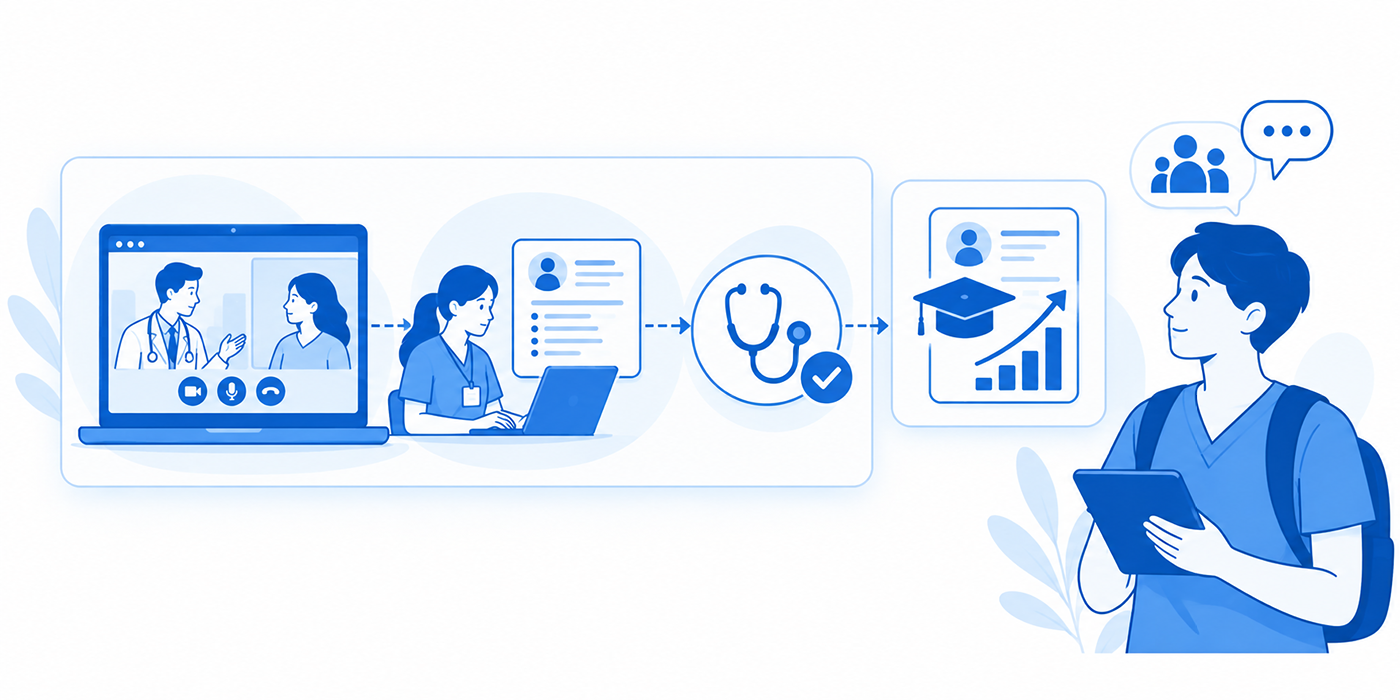
Virtual scribing covers several different employment arrangements. A live remote scribe joins a physician-patient encounter through an authorized audio or video connection, prepares documentation, and communicates with the clinician. An asynchronous scribe may review recorded encounters and prepare notes afterward. A third role involves proofreading AI-generated documentation, often with limited exposure to the actual encounter.
These distinctions influence the educational value of remote scribe positions. Live encounters can expose students to clinical reasoning, uncertainty, patient histories, and communication challenges. Retrospective documentation can strengthen medical transcription skills and medical-record accuracy, although the opportunities to understand patient interaction may be narrower.
Clinical exposure depends on the work you actually perform
Consider two applicants who each report 600 hours of virtual scribing.
Applicant A joins live family-medicine appointments, hears patients describe symptoms, documents medication discussions, clarifies ambiguous statements with the physician, and observes follow-up decisions. Their work provides firsthand exposure to the clinical encounter, even though they participate remotely.
Applicant B spends 600 hours formatting completed notes, correcting dictated terminology, and transferring information between documentation systems. This develops valuable healthcare administrative skills, but provides a narrower view of clinical practice.
Both applicants may legitimately report their paid work. The strength of each applicant's claim to medical or clinical employment depends on the responsibilities they can substantiate.
What virtual scribes can learn from clinical encounters
Strong virtual placements develop several competencies relevant to medicine:
Clinical reasoning exposure: observing how physicians interpret symptoms, examine available information, and determine next steps through encounter documentation.
Medical communication: recognizing how clinicians clarify vague complaints, explain uncertainty, and respond to concerns through therapeutic communication.
Documentation judgment: distinguishing patient-reported information from clinician findings while identifying medical documentation errors.
Professional reliability: protecting sensitive information, following patient privacy procedures, and communicating documentation concerns appropriately.
Healthcare teamwork: understanding physician workflows and effective clinical team communication.
An important limitation remains: observing patient care remotely develops different competencies from physically assisting patients. Premeds should recognize that distinction when comparing medical scribing with medical assisting.
The value of virtual scribing changes by specialty
A live ophthalmology scribe might develop detailed knowledge of visual-acuity documentation, examination terminology, and treatment discussions. A remote primary-care scribe may encounter chronic-disease management, medication reconciliation, and preventive counseling.
An emergency-department scribe could observe rapid decisions across different complaints, while an oncology scribe might follow complex longitudinal care.
Before choosing a role, compare medical scribe specialties according to encounter access, clinician interaction, feedback quality, and continuity of patient care.
Use the following 30-point evaluation table before accepting a virtual scribing offer. It identifies the experiences that can strengthen your application and the weaknesses that may require additional clinical exposure.
| # | Evaluation factor | Stronger clinical exposure | Weaker clinical exposure | How to strengthen your experience |
|---|---|---|---|---|
| 1 | Encounter access | Participates in live encounters remotely | Works exclusively on completed notes | Request supervised live encounter assignments |
| 2 | Patient communication | Hears patients describe symptoms firsthand | Reads summarized patient information | Add direct patient-facing volunteering |
| 3 | Physician interaction | Communicates regularly with the provider | Receives only automated assignments | Arrange scheduled provider feedback |
| 4 | Clinical reasoning | Observes differential diagnosis discussions | Receives only finalized diagnoses | Discuss general clinical reasoning with a supervisor |
| 5 | History-taking exposure | Documents live patient histories | Copies historical data | Improve HPI synthesis and accuracy |
| 6 | Physical examination | Observes examination or hears findings live | Only reads recorded findings | Seek approved in-person clinical observation |
| 7 | Continuity of care | Observes repeat visits and follow-up planning | Sees isolated encounters | Consider a longitudinal outpatient specialty |
| 8 | Patient vulnerability | Observes difficult care conversations | Handles only routine administrative records | Explore hospice or patient-support volunteering |
| 9 | Documentation accuracy | Receives feedback on clinically meaningful errors | Evaluated only on output speed | Track corrections and their causes |
| 10 | Medical terminology | Uses terminology in clinical context | Types unfamiliar words without understanding | Study medical transcription terminology |
| 11 | EHR proficiency | Works in an approved clinical records system | Only formats exported text | Improve medical records management knowledge |
| 12 | Physician continuity | Works repeatedly with the same physician | Random provider assignment every shift | Request consistent provider pairing |
| 13 | Recommendation potential | Physician directly observes professional growth | Minimal relationship with clinicians | Develop strong physician relationships |
| 14 | Healthcare workflow | Observes team communication and care coordination | Performs isolated documentation tasks | Learn how different clinical roles interact |
| 15 | Patient diversity | Observes varied clinical and social circumstances | Limited range of encounters | Develop cultural competence |
| 16 | Professional responsibility | Accountable for accurate documentation | Performs repetitive copying | Request appropriate documentation quality reviews |
| 17 | HIPAA awareness | Uses approved secure documentation procedures | Unclear privacy or access controls | Review patient privacy requirements |
| 18 | Interprofessional exposure | Observes referrals and clinical handoffs | Communicates only with a task coordinator | Learn healthcare team communication |
| 19 | Feedback quality | Receives actionable clinical documentation feedback | Only receives productivity warnings | Request measurable learning objectives |
| 20 | AI documentation | Evaluates clinical context and documentation accuracy | Blindly formats AI-generated notes | Build AI-era scribing skills |
| 21 | In-person clinical exposure | Has complementary direct patient interaction | All healthcare exposure occurs remotely | Add recurring patient-facing activities |
| 22 | Physician shadowing | Understands the physical clinical environment | Observes only an audio-based workflow | Arrange authorized in-person shadowing |
| 23 | Hours verification | Maintains accurate employment records | Relies on estimated hours | Maintain a verified clinical hours log |
| 24 | Reflection quality | Can discuss specific professional lessons | Can only describe repetitive duties | Write weekly de-identified reflections |
| 25 | AMCAS transparency | Clearly identifies the remote setting | Implies direct physical patient care | Describe responsibilities accurately |
| 26 | Employment ROI | Stable pay with meaningful learning opportunities | Low pay and limited professional growth | Calculate scribe employment ROI |
| 27 | Academic compatibility | Predictable shifts protect coursework and MCAT study | Frequent scheduling conflicts | Create an MCAT work-study schedule |
| 28 | Training structure | Includes supervised shifts and a remediation process | Immediate independent work without support | Seek structured training |
| 29 | Admissions suitability | Experience aligns with target-school expectations | Assumes all schools use identical standards | Confirm school-specific clinical requirements |
| 30 | Transferable skills | Builds communication, judgment, and accuracy | Develops only repetitive data-entry speed | Develop transferable healthcare skills |
2. Does Virtual Scribing Count as Clinical Experience for MD and DO Applications?
The Association of American Medical Colleges allows applicants to select the work-and-activities category that best describes their experience. Medical schools then evaluate the substance of that experience through their own admissions processes.
For a live virtual scribe who observes physician-patient encounters and contributes to clinical documentation, Paid Employment – Medical/Clinical may be a defensible AMCAS classification. The applicant should clearly disclose that the work occurred remotely and describe what they actually observed and performed.
For someone whose duties consist almost entirely of retrospective transcription or formatting, the clinical-experience classification becomes more debatable. A prehealth advisor or the admissions office at a target school can help clarify whether the role fits its expectations.
What medical schools actually evaluate
Medical schools frequently look for evidence that an applicant understands patient care, the responsibilities of physicians, the realities of healthcare delivery, and their own motivation to pursue medicine.
Published school guidance illustrates important differences. The University of Washington School of Medicine identifies scribing among relevant clinical experiences and emphasizes applicants' reflections. Duke University School of Medicine emphasizes sustained in-person patient care and firsthand relationships with patients.
These examples help explain why virtual clinical hours may receive different weight across institutions. Applicants should consult the current requirements of each target medical school, especially when remote scribing is their primary clinical activity.
Why direct patient contact carries additional value
An in-person clinical role exposes premeds to experiences that can be harder to access virtually: helping an anxious patient navigate a clinic, observing discomfort during a procedure, interacting with families, and understanding the physical demands of patient care.
An applicant with medical assistant experience may have opportunities to practice patient communication and observe healthcare teamwork at close range. An in-person emergency-department scribe may witness complex interactions that are less apparent through a remote connection.
Virtual scribes can develop complementary competencies through accurate medical documentation, provider communication, and clinical observation.
A strong application combines these forms of learning where feasible.
Are 1,000 virtual scribing hours enough?
There is no universal requirement that every medical-school applicant complete 1,000 clinical hours. Schools vary in their expectations, and raw hours alone cannot establish the quality of an experience.
A student with 1,000 hours of remote documentation and little patient interaction may still need opportunities to demonstrate their understanding of direct patient care. Another student with 400 hours of live virtual scribing, 150 hours of patient-facing volunteering, and sustained physician mentorship may be able to discuss a wider range of relevant experiences.
These figures illustrate portfolio differences rather than admissions cutoffs. Consult the medical scribe hours guide and evaluate whether scribing is worth it for premeds based on your own admissions readiness.
For DO applications, examine individual osteopathic schools' clinical expectations and the current AACOMAS instructions. The underlying principle remains important: describe the work accurately and demonstrate what it taught you.
3. What Reddit Premeds Say About Virtual Scribing: Four Recurring Arguments
Reddit discussions show considerable disagreement about whether remote scribing should receive the same recognition as traditional clinical employment. These are individual experiences and opinions rather than verified admissions decisions or representative survey findings.
Argument one: Live virtual scribing still involves real patient care
In a January 2023 r/premed discussion, a remote family-medicine scribe described working full-time alongside a physician through live connections with patients. The poster performed familiar scribe duties while working from home and asked whether the remote arrangement changed the classification.
Responses disagreed about the proper interpretation. Some considered live patient encounters sufficient for clinical classification; others favored additional in-person experience.
The distinction helps applicants evaluate strong clinical scribing based on activities rather than job titles. A student observing real discussions of symptoms, medications, and treatment can potentially explain more about medicine than someone completing isolated data-entry tasks.
Argument two: Remote exposure misses important patient interactions
A March 2025 discussion about remote scribing raised concerns that a virtual role might provide weaker admissions evidence than in-person clinical work. Several commenters recommended combining it with direct patient-facing experience.
A December 2024 discussion similarly distinguished remote chart editing from meaningful exposure to patient encounters.
These concerns deserve consideration when evaluating remote medical scribe jobs. Ask whether the role allows you to hear complete encounters, observe clinical decision-making, and receive substantive physician feedback.
When those opportunities are absent, combine the position with hospital volunteering or another patient-facing role.
Argument three: Existing clinical experience changes the decision
An August 2026 r/premed poster described having approximately 300 hours of in-person scribing and 500 additional hours of in-person clinical experience. The applicant was considering virtual scribing because it better suited their schedule while continuing in-person volunteering.
A response suggested that virtual work could remain valuable alongside the applicant's existing experience.
This illustrates a practical consideration: the same job can serve different purposes for different applicants.
Someone with substantial in-person experience may choose virtual scribing for income, specialty exposure, or an improved MCAT schedule. Someone beginning with zero clinical experience may benefit more from seeking a patient-facing position first.
Argument four: Job quality and AI are increasingly important
In another August 2026 discussion, former and current scribes described virtual work positively in some placements, citing supportive physicians and meaningful learning. Other commenters reported low pay, reduced hours, technical problems, and concerns about AI replacing documentation work.
These experiences make employer comparison especially important. A remote offer can become difficult to sustain when hours fluctuate or audio quality makes accurate charting unnecessarily stressful.
Review AI-related scribe career changes, remote hiring barriers, and low-pay employment trade-offs before committing to a long-term position.
Select your biggest concern and submit your vote to get a personalized recommendation.
Interactive self-assessment. Your selection is stored on this device.
4. How to Strengthen Virtual Scribing Experience Before Applying to Medical School
The most effective strategy addresses the specific weaknesses in your experience. A virtual scribe who already observes complete patient encounters needs a different improvement plan from someone whose work consists entirely of retrospective documentation.
Step one: Add recurring in-person patient contact
Aim to participate consistently in a setting where you encounter patients directly. Possibilities include hospital volunteering, hospice support, community clinics, patient navigation, or appropriately trained clinical employment.
Seek responsibilities that involve meaningful interaction rather than selecting opportunities based entirely on how quickly you can accumulate hours.
For example, supporting patients who are confused about clinic directions may develop patience, rapport-building skills, and awareness of healthcare access barriers.
Hospice volunteering may help you understand emotionally difficult care situations and practice therapeutic communication.
The combination of virtual documentation experience and sustained direct patient interaction creates a broader foundation for explaining your motivation.
Step two: Build deeper relationships with supervising physicians
Remote work can make relationship-building harder because informal clinic conversations occur less frequently.
Request periodic performance feedback, arrive prepared with appropriate questions about documentation, and demonstrate improvement in clinical accuracy.
A physician who has observed months of dependable work may be able to describe your professionalism, communication, and ability to incorporate feedback.
Review the principles behind earning a strong physician recommendation. A detailed letter grounded in specific observations can be more useful than a generic letter from a well-known physician.
Step three: Develop a structured reflection log
After each week, record three items:
A general clinical communication lesson you observed.
A professional skill you improved.
A question the experience raised about healthcare or the physician's responsibilities.
For example, observing repeated difficulties with medication adherence might prompt reflection on affordability, communication, or access to follow-up care.
Document the general lesson without storing protected patient details. Follow confidential communication procedures and patient privacy requirements.
This method produces stronger material for medical-school activity descriptions and interview conversations than a spreadsheet containing only total hours.
Step four: Build skills beyond transcription speed
Medical schools evaluate qualities such as communication, reliability, teamwork, empathy, and ethical responsibility.
Improve your clinical typing accuracy, medical documentation judgment, and professional communication.
Learn how medical interpreter services support patients with language barriers and how cultural competence affects healthcare communication.
These topics can deepen your understanding of clinical practice while making you a more capable scribe.
Step five: Maintain a balanced weekly schedule
Premeds frequently overestimate how much employment they can sustain alongside demanding coursework.
A student working twenty hours remotely may avoid commuting, yet documentation shifts can still create mental fatigue. During MCAT preparation, consider protecting study blocks before accepting additional shifts.
Use an MCAT and scribing time budget, monitor scribe burnout risks, and reconsider hours when your grades or recovery time begin deteriorating.
For students using a gap year, calculate the opportunity cost through a gap-year scribing assessment.

5. How to Present Virtual Scribing on AMCAS and Decide Whether It's Worth Continuing
Applicants sometimes make their virtual experience sound weaker by listing only tasks. Others create credibility problems by implying that remote work involved physical patient care.
Your application description should accurately identify the environment, the clinical responsibilities, and what you learned.
AMCAS categorization and experience descriptions
AMCAS permits applicants to identify the experience type that best fits their activities, and medical schools evaluate the information submitted.
A live remote scribe who meaningfully participates in clinical documentation may choose the Paid Employment – Medical/Clinical category when that classification accurately represents their work.
The title could read:
Virtual Medical Scribe – Family Medicine
A useful description might be:
"Supported a family-medicine physician remotely during live patient encounters by documenting histories, examinations, and care plans in the electronic health record. Clarified documentation questions with the physician and developed an understanding of chronic-disease management, clinical communication, and continuity of care."
Use only duties you actually performed. If your position involved asynchronous documentation, explicitly identify that arrangement.
AMCAS work-and-activities descriptions generally have a 700-character limit, with additional space for designated most-meaningful experiences. Check the application instructions for your specific cycle.
The clinical scribing application guide, medical school hours discussion, and physician letter guidance can help you develop a consistent application narrative.
How to answer the virtual scribing interview question
An interviewer may ask: "What did you learn about medicine from working remotely?"
Develop an answer around three elements: an actual clinical observation, its effect on your understanding of medicine, and how you explored that lesson further.
For instance, a live scribe may have observed physicians adjusting explanations when patients struggled to understand treatment recommendations. The applicant could discuss how this increased their appreciation for patient education and led them to seek direct patient interaction through volunteering.
The strongest responses reflect real experiences and provide concrete evidence of growth. Avoid making claims that you personally delivered care when your responsibilities were limited to documentation.
When virtual scribing is worth continuing
A virtual position may be worthwhile when it offers dependable pay, meaningful encounter access, supportive physicians, and predictable hours.
Evaluate your role through five practical questions:
Does the position provide learning beyond repetitive medical transcription?
Can you develop a genuine relationship with a physician who observes your work?
Do you have enough time for in-person clinical activities?
Are your earnings sufficient after accounting for the real cost of low-paid scribing?
Does your experience advance your application more effectively than alternative clinical opportunities?
If several answers are unfavorable, compare private-practice scribing, medical assistant positions, and other patient-facing roles.
Also consider the impact of AI documentation systems. Employers increasingly have options for automating portions of the charting workflow, making clinical understanding and quality assurance valuable transferable skills.
The decision ultimately depends on your complete application portfolio, including academic performance, service, patient exposure, professional relationships, and how convincingly you explain your motivation for medicine.
6. FAQs About Virtual Scribing and Premed Clinical Experience
-
Live virtual scribing can reasonably support a medical/clinical employment classification when the worker observes real patient encounters and performs genuine clinical documentation duties. Applicants should disclose the remote arrangement and describe their responsibilities accurately. Medical schools retain their own evaluation criteria, so consult clinical-experience guidance and verify requirements with target schools, especially when virtual scribing represents most of your clinical exposure.
-
Virtual scribing generally provides less exposure to the physical clinical environment and direct patient interaction. However, live remote work can still offer substantial physician observation and clinical documentation training. Applicants with limited patient-facing exposure should consider combining it with in-person medical employment or volunteering.
-
You can apply, subject to each school's requirements. A portfolio relying exclusively on virtual documentation may leave important questions about direct patient experience unanswered. Review how clinical hours are evaluated, examine each school's expectations, and develop meaningful patient-facing experience where feasible.
-
Asynchronous scribing develops terminology, documentation, and healthcare workflow knowledge. Its clinical classification is less clear when the worker edits records without participating in live encounters. Describe the responsibilities accurately and seek clarification from target schools or prehealth advisors. The distinction between remote documentation roles and direct clinical exposure matters.
-
Yes. A physician who regularly supervises your work may be able to describe your accuracy, professionalism, reliability, and ability to improve through feedback. The strength of the letter depends on the relationship and firsthand observations. Follow the principles for earning a physician recommendation and recognize that some schools may specifically seek evidence of direct patient-care interactions.
-
Remote employment can eliminate commuting and offer scheduling flexibility, but actual workloads vary considerably. Compare guaranteed working hours, shift predictability, and mental fatigue against your study requirements. A realistic MCAT study and scribing schedule can identify whether the role remains sustainable. Monitor burnout warning signs before increasing your workload.
