

A power outage can erase access to patient schedules minutes before a clinic opens. A cyberattack can disrupt prescriptions, while severe weather can prevent patients and staff from reaching the facility. Medical administrators need clear emergency procedures that preserve patient safety, protect confidential information, and maintain essential operations when normal systems fail. This guide explains emergency preparedness terminology, practical response protocols, downtime documentation, and recovery procedures for teams managing healthcare cybersecurity, secure patient communication, medical admin troubleshooting, and workflow automation.
1. Understanding Emergency Preparedness in Medical Administration
Emergency preparedness in medical administration involves identifying potential disruptions, developing response procedures, assigning responsibilities, and maintaining essential administrative functions during unexpected events.
A medical practice may face environmental emergencies, facility hazards, technology failures, infectious disease incidents, security threats, or shortages of critical supplies. Each event creates different operational consequences.
A power failure might interrupt registration and electronic record access. A flood may require evacuation or temporary closure. A ransomware incident may affect appointment information, clinician documentation, and communication systems simultaneously.
These situations require coordination between administrative personnel, clinical leadership, facilities management, information technology, and designated emergency responders.
Effective team communication, healthcare compliance procedures, medical office technology troubleshooting, and confidential communication practices establish the foundation for a coordinated response.
The Four Components of a Healthcare Emergency Preparedness Program
For organizations subject to applicable CMS emergency preparedness regulations, the framework includes four interconnected areas.
1. Risk assessment and emergency planning: Identify credible hazards, assess their consequences, and determine which services depend on vulnerable facilities, personnel, equipment, or technology.
2. Policies and procedures: Establish approved actions for situations such as evacuation, sheltering, interrupted patient care, equipment failures, and unavailable electronic records.
3. Communication planning: Define how staff contact emergency responders, clinical leadership, patients, external partners, and other authorized parties when ordinary communication channels fail.
4. Training and testing: Prepare employees for assigned responsibilities, evaluate response procedures through appropriate exercises, and correct deficiencies identified during testing.
Specific regulatory obligations vary according to provider type and applicable requirements. Each organization should verify the standards governing its operations.
Medical administrators contribute by maintaining accurate patient scheduling records, organizing authorized emergency communication workflows, supporting medical documentation continuity, and tracking outstanding tasks through approved healthcare automation systems.
The Emergency Decision That Medical Administrators Must Get Right
An employee discovers water entering a records-storage room while the electronic scheduling system remains operational.
The immediate questions concern personnel safety, whether electrical hazards exist, what information or equipment may be affected, and which authorized professional should direct the response.
Administrative staff should follow the facility's emergency procedures, notify designated personnel, and protect records only when doing so is safe and authorized.
They should also determine which patient-facing functions require immediate changes. Appointments may need to be delayed, transferred, or rescheduled after the appropriate leadership decision.
A reliable response preserves communication through patient interaction scripts, supports safe scheduling conflict management, and documents decisions using professional medical administration standards.
The Five Operational Priorities During an Emergency
An effective response follows a clear priority framework.
Life safety: Follow approved emergency actions and clinical escalation procedures.
Incident control: Activate designated leadership, establish responsibilities, and coordinate with emergency services when required.
Continuity of essential care: Determine which clinical services can safely continue and which require alternative arrangements.
Information protection: Maintain authorized access to required patient information while preserving privacy and security.
Accountable recovery: Document affected services, unresolved tasks, restoration decisions, and follow-up responsibilities.
These priorities should be reflected in the organization's phone triage communication, healthcare cybersecurity processes, team communication systems, and administrative workflow procedures.
A practical dictionary connecting emergency preparedness terminology with medical office responsibilities, realistic incidents, and required verification.
| # | Emergency Term | Operational Definition | Practical Example | Administrative Verification |
|---|---|---|---|---|
| 1 | All-Hazards Approach | Planning method addressing common consequences across multiple emergencies. | Power loss procedures support storm, fire, and technical outage scenarios. | Confirm the plan covers shared dependencies and hazard-specific exceptions. |
| 2 | Hazard Vulnerability Analysis (HVA) | Structured assessment of hazards, exposure, and potential operational impact. | A clinic assesses flooding, cyber incidents, and utility failures. | Review the scoring method, local hazards, and mitigation owners. |
| 3 | Emergency Operations Plan (EOP) | Approved plan describing coordinated response responsibilities and actions. | Employees reference the EOP when the facility must evacuate. | Verify approval, version, accessibility, and staff awareness. |
| 4 | Activation Trigger | Defined condition prompting emergency procedures or escalation. | An evacuation order triggers the approved facility response. | Confirm who may activate the plan and how activation is communicated. |
| 5 | Incident Command System (ICS) | Scalable structure for organizing incident roles and coordination. | A designated lead coordinates safety, operations, and communications. | Identify the appropriate leadership structure for the facility. |
| 6 | Incident Commander | Person assigned overall incident-management responsibility. | The designated leader approves operational restrictions. | Check authority, backup coverage, and decision logs. |
| 7 | Emergency Communication Tree | Defined sequence for contacting responsible staff and partners. | A supervisor alerts clinical leaders and assigned administrators. | Test current numbers, alternates, and acknowledgment procedures. |
| 8 | Communication Redundancy | Approved backup methods when primary communications fail. | An alternate contact method is used during a telephone outage. | Check availability, authorized use, and privacy safeguards. |
| 9 | Business Continuity Plan (BCP) | Strategy for sustaining priority operations through disruption. | The clinic maintains selected essential services during an outage. | Identify minimum staffing, dependencies, and alternate processes. |
| 10 | Critical Business Function | Activity whose interruption creates significant patient or operational consequences. | Identifying patients and coordinating time-sensitive care remain priorities. | Confirm dependencies, responsible staff, and fallback methods. |
| 11 | Recovery Time Objective (RTO) | Target duration for restoring a defined system or function. | An EHR service has an internally approved restoration target. | Check that the target reflects clinical and operational dependencies. |
| 12 | Recovery Point Objective (RPO) | Maximum targeted age of data restored after a disruption. | Backup policy defines an acceptable data-recovery point. | Determine how transactions newer than the backup will be reconciled. |
| 13 | Downtime Procedure | Approved temporary process used when essential systems are unavailable. | Staff use authorized paper registration during an EHR interruption. | Verify training, approved forms, and transition criteria. |
| 14 | Downtime Patient Identifier | Controlled identifier connecting temporary records to the correct patient. | A downtime form receives an approved tracking reference. | Ensure positive patient identification and duplicate prevention. |
| 15 | Patient Tracking Log | Controlled record of patient location, transfer, or disposition. | An evacuation team records an authorized patient transfer. | Confirm destination, responsible handoff, and secure handling. |
| 16 | Evacuation Plan | Approved process for moving people from a threatened area. | Staff guide patients to a designated safe assembly area. | Review routes, accessibility needs, accountability, and authority. |
| 17 | Shelter-in-Place | Protective action keeping occupants within an appropriate designated location. | An external hazard prompts use of approved interior shelter areas. | Confirm hazard-specific instructions and designated safe spaces. |
| 18 | Lockdown Procedure | Security response controlling access and movement during certain threats. | A credible nearby threat activates approved security instructions. | Follow the specific threat plan and emergency responder directions. |
| 19 | Personnel Accountability | Process for determining the status of people affected by an incident. | A designated lead reconciles staff and patient presence after evacuation. | Document missing-person concerns and notify responders promptly. |
| 20 | Clinical Escalation | Transfer of a potentially urgent concern to qualified clinical personnel. | An administrator reports worsening symptoms during an outage. | Confirm receipt through the approved clinical pathway. |
| 21 | Protected Health Information (PHI) | Identifiable health information protected under applicable privacy rules. | Temporary patient tracking records contain identifying information. | Control access and evaluate permitted emergency disclosures. |
| 22 | Cyber Incident Containment | Authorized actions to limit the spread or impact of a security incident. | IT personnel isolate affected systems under the incident plan. | Preserve reporting, evidence, and clinical continuity responsibilities. |
| 23 | Backup Validation | Process verifying that retained backup data is restorable and usable. | A technical team tests record restoration in a controlled environment. | Check integrity, recovery procedures, and availability of required records. |
| 24 | Temperature Excursion | Storage condition outside approved limits for temperature-sensitive inventory. | A refrigerator alarm activates after power loss. | Follow product-specific assessment and authorized handling rules. |
| 25 | Supply Chain Disruption | Interruption affecting essential materials or services. | A delivery failure affects scheduled clinical procedures. | Identify safe inventory, substitutes approved by clinicians, and impacted visits. |
| 26 | Alternate Care Arrangement | Approved arrangement for continuing care when normal operations are disrupted. | An affected service is referred to an authorized partner facility. | Confirm capacity, appropriate clinical handoff, and patient communication. |
| 27 | Tabletop Exercise | Scenario-based discussion used to evaluate emergency decisions. | Staff work through a simulated EHR outage. | Identify decisions, deficiencies, owners, and required improvements. |
| 28 | After-Action Review (AAR) | Structured examination of response performance after an incident or exercise. | A team reviews communication failures after an outage drill. | Capture verified findings and actionable corrections. |
| 29 | Corrective Action Plan | Assigned work addressing deficiencies discovered during review. | An outdated contact list receives an owner and retest date. | Require closure evidence rather than task acknowledgment alone. |
| 30 | Return-to-Service Authorization | Approved decision permitting affected services to resume after validation. | Leadership reopens registration after systems and records are verified. | Record safety checks, dependencies, approver, and outstanding restrictions. |
ACMSO Emergency Preparedness Reference. These terms support staff training and planning; actual response actions must follow the facility's approved emergency policies, clinical guidance, and applicable regulatory requirements.
2. Tutorial: Building a Medical Office Emergency Preparedness Plan
An emergency preparedness plan becomes useful when employees can follow it under pressure, during system failures, and without access to their usual supervisors.
The plan should translate potential hazards into specific actions, named responsibilities, fallback procedures, and documented recovery requirements.
The following eight-step tutorial is designed for medical administrative teams coordinating patient scheduling systems, clinical team communication, healthcare cybersecurity, and medical documentation procedures.
Step 1: Create a Hazard Vulnerability Assessment
Identify the disruptions most likely to affect the organization and the consequences of each event.
A clinic in a flood-prone location may prioritize water damage and transportation interruptions. A multisite organization may need additional preparation for communication outages, cyberattacks, and failures affecting shared technology.
A simple internal screening method can use three ratings, each scored from 1 to 5:
Likelihood: How plausible is the event within the planning period?
Impact: How seriously would it affect patients, personnel, or operations?
Preparedness gap: How significant are the organization's current weaknesses?
Multiplying the ratings produces an illustrative prioritization score ranging from 1 to 125.
For example, a power outage rated 4 for likelihood, 4 for impact, and 3 for preparedness gap produces a score of 48.
This score helps prioritize planning discussions. Immediate life-safety requirements and regulatory obligations still require appropriate attention regardless of the numerical score.
Review past incidents, building dependencies, local emergency information, and staff observations through medical admin troubleshooting, team communication records, and appropriate healthcare compliance documentation.
Completion standard: Each priority hazard has a documented consequence, existing safeguard, preparedness gap, and responsible planning owner.
Step 2: Identify Essential Functions and Dependencies
Determine which activities must remain available to protect patients and support authorized clinical operations.
Examples include patient identification, access to essential medical information, communication with clinicians, urgent clinical escalation, and coordination of patients affected by service interruptions.
For each activity, document the people, systems, equipment, and external services required.
Consider a registration process dependent on electricity, internet access, an EHR, a printer, and an identity verification procedure.
If any dependency becomes unavailable, the practice needs an approved alternative or a decision about whether the activity can continue.
Map these relationships using cloud-based EMR guidance, patient scheduling integration terminology, healthcare automation tools, and secure communication systems.
Completion standard: Every essential function has a primary method, a documented fallback, and an authority responsible for deciding when that fallback may be used.
Step 3: Define Incident Roles and Backup Personnel
A small medical office may combine several incident responsibilities under one trained employee. Larger organizations may use a formal incident command structure.
Regardless of size, the plan should establish who can activate emergency procedures, direct staff, coordinate clinical decisions, communicate with patients, and authorize service restoration.
A practical role assignment might include:
Incident lead: Coordinates overall response, activates approved procedures, and maintains the incident decision record.
Clinical lead: Determines clinical service restrictions, clinical escalation, and patient-care priorities.
Administrative coordinator: Manages affected appointments, patient notifications, temporary registration processes, and task tracking.
Technology lead: Coordinates system outages, cyber incident reporting, technical recovery, and approved access.
Facilities or safety lead: Coordinates building hazards, security concerns, evacuation arrangements, and relevant environmental checks.
Every critical role should have a designated backup.
Staff should be trained through professional medical administration guidance, assertive communication techniques, and reliable team communication procedures.
Completion standard: An employee can identify the responsible incident lead and appropriate clinical escalation contact without relying on an unavailable person or system.
Step 4: Build an Emergency Communication Tree
The communication plan should include internal personnel, emergency responders, essential vendors, relevant healthcare partners, and authorized external agencies.
For every contact, record the operational role, primary communication method, alternate method, and responsible updater.
Avoid relying exclusively on a contact list stored inside the system most likely to become unavailable during an emergency.
Maintain an approved accessible backup with appropriate security protections.
The plan should also define who may communicate service closures, transfer arrangements, or reopening decisions to patients.
For patient-facing messages, prepare approved templates supporting secure messaging, appointment reminder systems, verbal communication, and patient interaction scripts.
Practical test: Simulate an unavailable primary telephone system. Verify that staff can contact the designated lead and an essential external partner through an approved alternate method.
Step 5: Develop a Downtime Registration and Documentation Procedure
When electronic systems fail, patient identification and information accuracy become particularly important.
Temporary records should use approved forms, authorized identifiers, clear timestamps, and traceable authorship.
A downtime appointment record might contain the patient's verified identity reference, visit category, clinician, scheduled time, administrative status, and responsible employee.
Sensitive medical information should be limited to what the approved process requires and protected from unauthorized access.
Use separate tracking for confirmed existing appointments, new requests, cancellations, and unresolved transactions.
A major hazard is creating duplicate patient or appointment records when electronic systems return.
Prevent this through established medical documentation controls, confidential communication procedures, cloud-based EMR workflows, and technical troubleshooting rules.
Completion standard: Staff can document a controlled test encounter during an outage and reconcile it accurately after restoration.
Step 6: Plan Patient Evacuation and Continuity of Care
Evacuation procedures should address facility layout, accessible routes, patient mobility needs, authorized assistance, communication methods, and safe destinations.
The actual protective action depends on the hazard and instructions from designated emergency personnel.
For example, a fire may require evacuation, while a particular external environmental hazard may require sheltering inside an appropriate area.
Clinical teams determine medical needs and necessary care arrangements. Administrators support patient identification, attendance accountability, approved transportation coordination, and communication records.
Patient tracking should preserve the appropriate information needed for authorized transfers and follow-up.
These procedures require clinical team communication, confidential patient communication, and consistent medical administration documentation.
Completion standard: A designated employee can explain how affected patients will be accounted for, how necessary clinical handoffs occur, and where unresolved tracking issues are escalated.
Step 7: Establish Decision Rules for Closures and Service Restrictions
Every disruption creates decisions about whether specific services can safely continue.
These decisions should be made by the appropriate authorized leadership based on the actual hazard, required personnel, available resources, and clinical capabilities.
Examples of conditions requiring formal review include unavailable emergency equipment, compromised patient records, unsafe environmental conditions, or interrupted utilities essential to a service.
After leadership determines the operational status, administrative staff should identify affected appointments and coordinate appropriate notifications.
The scheduling workflow should distinguish canceled appointments, approved transfers, rescheduling requests, and cases requiring clinical review.
Use patient scheduling systems, scheduling conflict management, appointment reminder software, and phone triage communication to support safe handling.
Completion standard: Service restrictions have documented authorization, affected appointment lists, patient communication plans, and conditions for reconsideration.
Step 8: Test the Plan Before an Actual Emergency
A tabletop exercise allows employees to work through an emergency scenario and explain the decisions they would make.
For example, announce a fictional scenario:
At 9:15 AM, the clinic loses internet access and the EHR becomes unavailable. Twelve patients are scheduled during the next two hours. A patient reports a time-sensitive clinical concern, and the primary telephone connection is also disrupted.
Ask participants to identify the incident lead, describe the downtime activation process, explain how patients will be identified, and demonstrate the alternate communication chain.
Record incorrect assumptions, missing supplies, inaccessible contact information, and unclear handoffs.
Then convert each deficiency into an assigned corrective action.
Training should include staff using medical admin technology systems, patient scheduling tools, secure messaging platforms, and team communication procedures.
Completion standard: Every significant exercise deficiency has a responsible owner, a correction deadline, and an appropriate verification test.
3. Emergency Response Scenarios Every Medical Administrator Should Practice
An emergency plan must account for the failures that happen while staff are managing patients, telephone calls, insurance tasks, and appointment changes simultaneously.
The following scenarios provide practical response workflows. Each should be adapted to the facility's approved emergency operations plan and rehearsed using relevant team communication protocols, medical admin troubleshooting, healthcare cybersecurity safeguards, and patient communication procedures.
Scenario 1: The Clinic Loses Electricity During Patient Hours
Situation: The facility experiences a complete power outage at 11:20 AM. Registration computers stop working, some rooms lose lighting, and a medication refrigerator alarm activates.
The designated incident lead and clinical personnel must assess immediate safety concerns, essential equipment availability, and which services can continue under approved procedures.
Administrative staff should identify affected appointments, determine whether authorized downtime records are available, and prepare communications after leadership establishes the service status.
The refrigerator alarm requires prompt handling by the designated storage-management personnel. Temperature-sensitive supplies may need to be restricted pending appropriate assessment.
Avoid independently deciding that affected medications or vaccines remain usable.
Once electricity returns, verify that important applications, devices, and required clinical resources are functioning before the authorized return-to-service decision.
Failure to prevent: Resuming patient services merely because the lights have returned, while critical equipment or data systems remain unverified.
Coordinate the response through cloud-based EMR procedures, medical technology troubleshooting, scheduling integration controls, and team communication systems.
Scenario 2: Ransomware Disrupts Patient Registration and Clinical Records
Situation: Employees begin receiving unexpected login errors. Several systems display suspicious messages, and patient schedules become inaccessible.
Staff should report indicators immediately through the approved cybersecurity incident pathway.
Authorized technology personnel determine containment, evidence preservation, investigation, and system recovery actions. Employees should follow their instructions regarding affected devices and accounts.
Administrators must preserve patient safety through approved downtime procedures, record affected transactions, and distinguish verified existing appointments from new requests.
Avoid transferring protected information to personal email accounts, consumer file-sharing services, or unapproved devices to bypass the disruption.
An important recovery step is determining whether the restored data represents the complete transaction history. If the system is restored from an earlier backup, staff may need to reconcile more recent bookings, clinical documents, and patient communications.
Failure to prevent: Reintroducing inaccurate or incomplete records into patient care because a restored application appears operational.
This scenario should be rehearsed using healthcare cybersecurity training, confidential communication procedures, cloud-based EMR workflows, and healthcare compliance controls.
Scenario 3: Severe Weather Prevents Staff and Patients From Reaching the Facility
Situation: A major storm disrupts roads, public transportation, and staffing availability. The clinic building remains intact, but several scheduled services lack required personnel.
The designated leadership must determine which operations can continue safely and which services require cancellation, transfer, or rescheduling.
Administrative staff should generate a verified list of affected appointments, prioritizing time-sensitive matters for appropriate clinical review.
Patient notifications should clearly state confirmed changes, available contact channels, and next steps. Communications should avoid promises about reopening before leadership has made that decision.
Where permitted and clinically appropriate, selected services may be reassigned or conducted remotely under approved policies.
Failure to prevent: Automatically rescheduling every affected patient without identifying which appointments require clinical prioritization or continuity planning.
The process should connect patient scheduling integrations, appointment reminder systems, secure patient messaging, and phone triage communication.
Scenario 4: A Fire Alarm Activates While Patients Are Receiving Care
Situation: A fire alarm sounds during a busy outpatient session, with patients in reception and examination rooms.
Staff should follow the facility's approved emergency action plan and directions from authorized responders.
Designated personnel coordinate evacuation or other appropriate protective action, including assistance for people with mobility, communication, or accessibility needs.
Administrative staff support accountability, identify known appointment and visitor information where available, and communicate missing-person concerns to emergency personnel promptly.
They should avoid entering unsafe areas to retrieve paperwork or equipment.
After occupants reach an appropriate safe location, patient tracking and required clinical handoffs should continue through authorized procedures.
Failure to prevent: Treating the appointment attendance list as definitive proof that everyone has left the building. Actual presence and safe disposition require verification.
Relevant preparation includes team communication training, professionalism in medical administration, confidential communication safeguards, and written documentation procedures.
Scenario 5: A Patient Reports Potentially Urgent Symptoms During a System Outage
Situation: The patient portal is unavailable, and a patient calls reporting symptoms that may need immediate medical attention.
The administrative employee should follow the established emergency and clinical escalation protocols, communicating the reported concern to appropriately qualified personnel.
If the situation requires emergency services under the applicable protocol, those services should be contacted through the designated emergency channel.
The absence of electronic records increases the importance of clear patient identification, contact information, and documented communication.
When the clinical team has taken responsibility, administrative staff can support approved follow-up tasks and record reconciliation.
Failure to prevent: Placing a potentially urgent concern into a routine callback queue simply because the normal electronic triage workflow is unavailable.
Prepare staff using phone triage communication guidance, therapeutic communication techniques, verbal communication skills, and secure team messaging.
Scenario 6: A Suspected Infectious Exposure Affects Front-Desk Operations
Situation: A possible infectious exposure is reported in an administrative or patient-facing area.
The responsible clinical or infection prevention personnel should assess the exposure and direct appropriate actions according to established policies.
Administrative employees may need to identify potentially affected work areas, preserve accurate scheduling information, and support authorized communications.
Any cleaning, isolation, personal protective equipment, or exposure-management decisions should follow the appropriate clinical and infection prevention procedures.
When patient or staff information is requested, verify whether the disclosure is authorized and use an approved channel.
Failure to prevent: Broadcasting identifiable patient information to employees who have no relevant role in the response.
Review confidential communication rules, healthcare compliance software, secure messaging procedures, and team communication workflows.
Scenario 7: The Telephone and Internet Connections Fail Simultaneously
Situation: A network incident interrupts inbound calls, online scheduling, and secure electronic messages.
Staff should activate the approved alternate communications process and determine which essential parties must be contacted.
Administrators need to know whether outbound communication remains available through an authorized alternative and how to record incoming requests during the interruption.
A secure, current backup contact list becomes essential when the primary directory is inaccessible.
The plan should also cover how patients will receive information about service interruptions through authorized channels.
Failure to prevent: Allowing time-sensitive patient requests to accumulate in communication systems that nobody can monitor during the outage.
Test the scenario through medical admin technology troubleshooting, team communication exercises, secure healthcare messaging procedures, and workflow automation controls.
Scenario 8: A Critical Supply Delivery Is Delayed Before Scheduled Procedures
Situation: A vendor informs the practice that an essential item will not arrive before several planned services.
The clinical lead or responsible personnel determine which services can proceed with available approved supplies and which require alternative arrangements.
Administrative staff should identify affected appointments and their current administrative status while avoiding independent substitutions involving clinical supplies.
Confirm any revised schedule against actual provider, equipment, and resource availability.
Document vendor communication, affected appointments, approved decisions, and outstanding actions.
Failure to prevent: Treating an unverified replacement item as interchangeable with an approved clinical supply or confirming a procedure before the necessary resources are available.
Coordinate the response through scheduling conflict management, professional medical administration, written communication standards, and healthcare workflow automation.
Select your biggest emergency preparedness challenge, then submit your vote to reveal a practical solution.
Test offline patient identification, controlled appointment tracking, clinical escalation, and EHR recovery procedures. Assign a downtime coordinator and verify that temporary records can be reconciled after restoration.
Establish an incident reporting chain, technical containment responsibilities, approved downtime procedures, and secure backup validation. Train staff to recognize suspicious system behavior and report incidents promptly.
Review accessible evacuation routes, trained assistance roles, patient accountability procedures, and designated assembly locations. Practice transferring essential patient information through authorized channels.
Identify equipment and supplies that depend on electricity. Document backup power arrangements, refrigeration monitoring, temperature excursion procedures, and authorized decisions about affected inventory.
Develop emergency closure communication templates, clinical review procedures for time-sensitive appointments, approved alternative care arrangements, and a reliable system for tracking unresolved patient requests.
ACMSO Interactive Emergency Preparedness Assessment. Your selection displays personalized guidance locally. Votes are not stored or counted.
4. Medical Office Downtime Management: Protecting Patients, Records, and Essential Services
A successful downtime response requires a controlled transition from normal systems to approved temporary operations, followed by accurate reconciliation.
A computer screen returning to normal provides only one part of the recovery evidence. Staff must also verify that records, appointments, communications, and clinical workflows remain trustworthy.
This section explains how medical administrators can organize downtime using cloud-based EMR systems, patient scheduling integrations, confidential communication procedures, and healthcare cybersecurity controls.
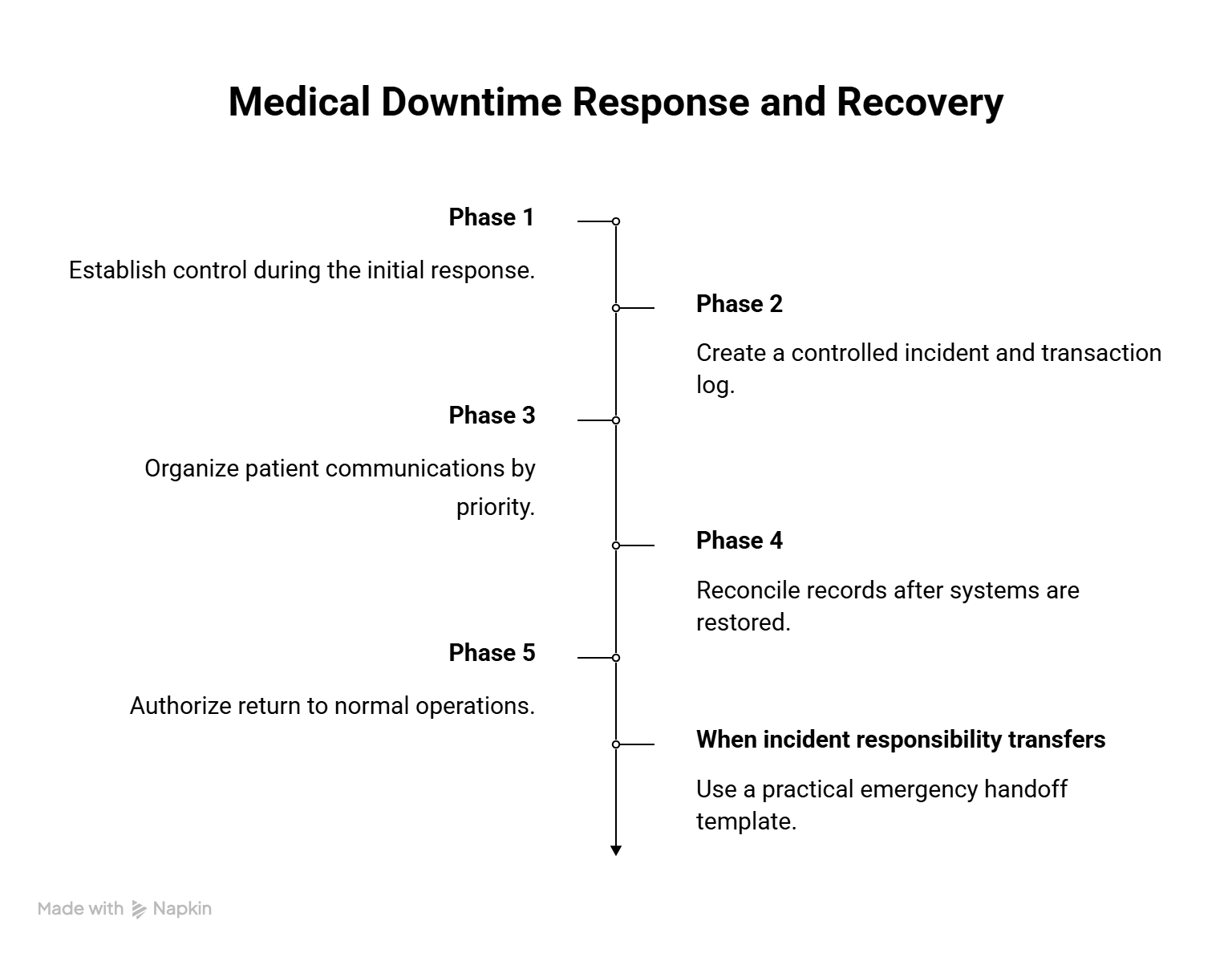
Phase 1: Establish Control During the Initial Response
The first actions should address immediate safety, incident reporting, and operational authority.
The designated lead identifies the affected services and determines whether emergency procedures or clinical restrictions are required.
Administrative personnel should establish which communication channels remain reliable, identify essential outstanding patient requests, and determine where approved downtime forms or instructions can be accessed.
A controlled initial response should answer five questions:
Which essential systems or services have been affected?
Who has authority to coordinate the response?
Which patients or current activities require immediate clinical attention?
Which approved alternative processes are available?
How will decisions and unresolved actions be recorded?
These questions can be adapted into a short incident activation checklist.
During a cyber incident, employees must follow the authorized security team's instructions concerning devices, networks, credentials, and evidence.
During a facility incident, the appropriate safety and emergency response instructions take precedence.
Support these processes with team communication protocols, medical admin troubleshooting, phone triage communication, and professional administrative procedures.
Phase 2: Create a Controlled Incident and Transaction Log
The incident log should establish a reliable history of decisions and significant events.
Use an approved format containing the incident reference, date and time, affected systems, responsible incident lead, operational restrictions, key decisions, and outstanding actions.
Administrative transaction logs should be maintained separately where needed to protect patient privacy and make reconciliation manageable.
An illustrative downtime appointment entry might contain:
The approved temporary transaction identifier.
The verified patient identification reference.
The appointment or service category.
The applicable clinician or department.
The original appointment date and time, if verified.
The requested action, such as check-in or rescheduling.
The responsible employee and action timestamp.
The final disposition and reconciliation status.
A patient-facing request should be distinguished from a confirmed appointment throughout the outage.
Use clear written communication standards, appropriate confidentiality controls, and approved medical documentation workflows.
Verification: Each controlled test transaction can be traced from its initial downtime record to its final status after restoration.
Phase 3: Organize Patient Communications by Priority
During an extended disruption, patients may need information about service restrictions, appointment changes, transfer arrangements, or how to contact the facility.
Communication should be organized according to the decisions made by authorized leadership and any relevant clinical priorities.
A practical communication matrix includes four audiences.
Current patients: Provide appropriate information about immediate service changes, protective actions, and relevant clinical handoffs.
Upcoming appointments: Send verified scheduling changes, including whether the appointment remains confirmed, has been canceled, or requires further review.
Employees and clinicians: Communicate assigned tasks, available resources, operational restrictions, and updates through approved internal channels.
External partners: Coordinate with authorized laboratories, vendors, healthcare organizations, and relevant public agencies when their involvement is necessary.
Avoid disclosing identifiable patient information in public closure notices or broadly distributed messages.
HIPAA permits certain disclosures for treatment and other legally recognized purposes during emergencies, subject to applicable requirements. Additional confidentiality rules may apply depending on the information involved and the recipient.
Use secure patient messaging, appointment reminder tools, confidential communication guidance, and healthcare compliance procedures.
Phase 4: Reconcile Records After Systems Are Restored
Restoration creates a particularly important administrative risk: temporary records and electronic transactions may describe the same patient activity differently.
Suppose a patient cancels an appointment while the EHR is offline. Staff record the cancellation on an approved downtime form.
After restoration, the electronic calendar still shows the appointment as confirmed.
A controlled reconciliation process should verify the patient's identity, locate the original appointment, apply the authorized cancellation, record the action, and confirm that connected applications display the correct final state.
For appointment reconciliation, distinguish four categories:
Existing appointments: Confirm that previously accepted bookings remain accurate.
New downtime requests: Determine whether they can be entered and confirmed without duplicate records or capacity conflicts.
Changes to existing appointments: Apply approved cancellations, rescheduling, and related status updates.
Unresolved transactions: Assign cases requiring additional verification or clinical review.
Clinical records require their own authorized reconciliation and authentication process.
Test changes through patient scheduling integrations, cloud-based EMR systems, workflow automation tools, and technical troubleshooting procedures.
Verification: No downtime transaction is marked reconciled until the responsible employee can confirm its authoritative final record or approved disposition.
Phase 5: Authorize Return to Normal Operations
The return-to-service decision should reflect the condition of each affected function.
A facility recovering from a network outage may need to verify application access, patient records, communication systems, device connectivity, and pending transactions.
A clinic recovering from flooding may additionally require building safety, environmental checks, and equipment assessments before affected areas can reopen.
The appropriate authorized leadership should approve service restoration according to organizational procedures.
A useful validation record includes the affected service, required verification, test result, remaining restriction, responsible reviewer, and approval time.
Example: A practice management application becomes available after a prolonged outage. The team confirms that authorized users can retrieve existing appointments and process test transactions, then begins controlled reconciliation. Only appropriately verified services are returned to normal use.
Maintain this evidence using medical admin documentation standards, healthcare compliance tools, technology troubleshooting records, and professional team communication.
A Practical Emergency Handoff Template
When incident responsibility transfers between employees or shifts, the handoff should establish the current situation and the next required decisions.
Use these fields:
Incident and status: Incident identifier, current operational phase, and affected services.
Safety and clinical issues: Unresolved high-priority concerns and their responsible clinical or emergency pathways.
Systems and resources: Applications, equipment, facilities, or supplies still unavailable or restricted.
Patient-facing impact: Affected appointment groups, outstanding requests, and approved communication status.
Required next actions: Task, priority, owner, deadline, and relevant escalation contact.
Pending decisions: Actions awaiting authorized leadership approval.
Handoff acknowledgment: Sending and receiving employee, relevant time, and confirmation under organizational policy.
This record can be supported by team communication systems, secure healthcare messaging, and workflow automation platforms.
The receiving employee should be able to identify every unresolved critical issue without reconstructing the entire incident from disconnected messages.
5. Measuring Emergency Preparedness: Key Metrics, Drills, and Improvement Plans
A written emergency plan provides limited assurance unless staff can use it successfully during a realistic disruption.
Preparedness should be evaluated through controlled exercises, clearly defined performance measures, and evidence that previously identified deficiencies have been corrected.
The most useful metrics examine communication reliability, employee readiness, essential service continuity, data reconciliation, and the effectiveness of recovery decisions.
These measurements can be supported through healthcare compliance software, workflow automation reporting, medical admin troubleshooting records, and team communication systems.
Metric 1: Emergency Contact Acknowledgment Rate
Calculation: Designated contacts who acknowledge a test message through the required process ÷ designated contacts included in the test × 100.
Suppose a clinic tests its emergency communication tree with 40 employees, and 36 acknowledge the message within the approved test window.
The acknowledgment rate is 90%.
Review which personnel failed to respond, whether their contact information was current, and whether their backup contacts worked.
Measure the time required to reach key decision-makers separately from the overall acknowledgment percentage.
Use team communication procedures, secure messaging tools, and appropriate verbal communication standards to resolve communication gaps.
Metric 2: Time to Activate an Approved Downtime Process
Calculation: Elapsed time between the defined incident recognition event and verified activation of the required downtime procedure.
For example, staff identify an EHR outage at 10:05 AM, and the designated team confirms that approved downtime registration is operational at 10:17 AM.
The measured activation interval is 12 minutes.
This metric should distinguish the time required to recognize the incident from the time required to activate the fallback.
A shorter interval is valuable when the resulting workflow remains accurate, safe, and authorized.
Review results through cloud-based EMR troubleshooting, medical admin technology procedures, and professional team coordination.
Metric 3: Downtime Transaction Reconciliation Rate
Calculation: Downtime transactions with verified final dispositions ÷ total downtime transactions requiring reconciliation × 100.
Suppose an outage produces 80 controlled temporary transactions. After restoration, 72 receive verified final dispositions.
The reconciliation rate is 90%.
The remaining eight transactions should remain visible in an assigned exception worklist.
Classify unresolved cases by patient identification concerns, missing records, duplicate bookings, clinical documentation requirements, and other verified reasons.
Use patient scheduling integrations, medical documentation procedures, cloud-based EMR workflows, and workflow automation to support reconciliation.
Metric 4: Emergency Exercise Objective Completion Rate
Calculation: Exercise objectives completed to their defined acceptance criteria ÷ total applicable exercise objectives × 100.
A tabletop exercise might evaluate ten objectives, including identifying the incident lead, activating downtime procedures, communicating a closure decision, and demonstrating patient tracking.
If eight meet their predefined standards, the completion rate is 80%.
An objective should count as completed only when the evaluator can verify the required performance.
Review the two unsuccessful objectives and assign appropriate corrective actions.
Test staff knowledge of phone triage communication, confidential communication, medical admin troubleshooting, and team communication procedures.
Metric 5: Corrective Action Closure Rate
Calculation: Preparedness improvement tasks completed and verified by their deadlines ÷ tasks due for completion × 100.
Suppose an after-action review produces 20 corrective tasks. Seventeen are completed and verified by the agreed deadlines.
The closure rate is 85%.
Distinguish task acknowledgment from verified resolution. A contact-list problem remains unresolved until the corrected list is available and its relevant communications have been tested.
Record overdue tasks according to impact and priority.
Review outstanding actions through workflow automation reporting, healthcare compliance monitoring, and written administrative documentation.
Metric 6: Critical Function Recovery Performance
For each essential service, compare actual verified restoration time with its approved recovery time objective.
For example, a system has an internally established restoration target of four hours. A controlled recovery test demonstrates verified restoration in three hours and 20 minutes.
The test meets that target.
However, the assessment should also verify that the restored service contains appropriate information and supports its required operational functions.
For systems with recovery point objectives, evaluate the age and completeness of restored data separately.
An apparently successful technical restoration can still leave unresolved clinical or administrative transactions.
Use healthcare cybersecurity guidance, cloud-based EMR procedures, and medical admin troubleshooting to evaluate recovery integrity.
Metric 7: High-Priority Preparedness Deficiency Rate
Calculation: High-priority preparedness controls failing during an audit or exercise ÷ total applicable high-priority controls evaluated × 100.
If three of 25 high-priority controls fail, the deficiency rate is 12%.
Potential deficiencies include an unavailable emergency contact, inaccessible downtime instructions, a failed backup communication pathway, or missing equipment-response ownership.
Classify each failure by hazard, affected function, severity, and responsible team.
Repeat the relevant test after corrective action to confirm effectiveness.
This process strengthens professional medical administration, healthcare compliance workflows, and team communication accountability.
A 14-Day Emergency Preparedness Implementation Plan
Days 1–2: Review hazards and essential services. Identify credible disruptions, patient-care dependencies, facility vulnerabilities, and critical technology. Examine previous incidents and outstanding technical troubleshooting records.
Days 3–4: Establish incident roles and communication contacts. Confirm authorized decision-makers, backup personnel, internal contact details, essential vendors, and permitted alternate communication methods. Review team communication procedures and secure messaging safeguards.
Days 5–6: Prepare downtime materials. Verify that approved forms, patient identification methods, registration instructions, transaction logs, and reconciliation procedures are available through the authorized fallback process.
Days 7–8: Document patient continuity pathways. Review processes for service closure, clinical escalation, appointment changes, patient tracking, and approved external coordination. Confirm alignment with patient scheduling systems and phone triage communication.
Days 9–10: Conduct a controlled tabletop exercise. Use an EHR outage, power failure, or locally relevant hazard. Observe whether staff can locate instructions, identify leaders, communicate appropriately, and activate approved fallback procedures.
Days 11–12: Document deficiencies and corrections. Assign owners and deadlines to missing contact information, unclear responsibilities, unavailable supplies, or incomplete reconciliation processes.
Days 13–14: Retest and obtain authorized review. Verify high-priority corrections and document remaining gaps. Have the appropriate leadership review the plan and establish the ongoing training and exercise schedule.
This 14-day framework supports initial readiness improvements. Applicable emergency preparedness requirements, including review and training intervals, must be determined by the organization's provider type and regulatory obligations.
The Most Valuable Result of an Emergency Preparedness Exercise
The strongest exercise outcome is an accurate record of what staff could perform, what remained uncertain, and what must change before a real incident.
For every significant deficiency, record the failed control, operational consequence, corrective action, assigned owner, deadline, and verification method.
A failed communication-tree test should produce an updated contact process and successful retest. A downtime documentation exercise revealing duplicate-record risks should result in revised reconciliation controls.
Link these improvements to workflow automation systems, healthcare compliance records, written communication procedures, and professional team coordination.
6. Frequently Asked Questions About Emergency Preparedness for Medical Administrators
-
Medical administrators support emergency readiness through communication coordination, accurate patient records, appointment management, documentation, and assigned operational tasks.
Responsibilities may include maintaining current contact information, preparing approved downtime forms, tracking affected appointments, communicating authorized service changes, and documenting unresolved issues.
Clinical assessment, emergency response decisions, and technical containment actions remain with appropriately qualified or designated personnel.
An effective administrative response uses team communication procedures, patient scheduling tools, professional medical administration standards, and healthcare compliance controls.
Every assigned responsibility should have an authorized owner and a documented backup.
-
Medical offices should maintain appropriate physical, administrative, and technical safeguards while following applicable emergency disclosure rules.
HIPAA permits certain disclosures for treatment, public health, and other recognized purposes. The applicable rules depend on the recipient, purpose, and type of information. The minimum necessary standard applies to some disclosures and has specific exceptions, including disclosures to healthcare providers for treatment.
Temporary records, patient tracking lists, and backup communication channels must be managed through approved procedures.
Staff should verify identity and authorization before sharing sensitive information.
Review confidential communication guidance, healthcare cybersecurity practices, and secure healthcare messaging.
-
Activate the approved downtime procedure and notify the designated clinical and technical personnel.
Verify which functions remain accessible and determine whether essential services can safely continue.
Use authorized temporary registration, patient identification, and documentation methods where permitted. Record transactions clearly so they can be reconciled after restoration.
Staff should avoid creating unverified appointments or duplicate patient records.
Prioritize any clinical concerns through the appropriate escalation pathways.
Review cloud-based EMR workflows, medical admin troubleshooting procedures, patient scheduling integration controls, and written documentation standards.
-
Evacuation involves moving people away from an affected area through an approved protective procedure.
Shelter-in-place involves remaining within an appropriate designated location because of a particular external hazard or other circumstance.
Lockdown involves specified security measures to manage certain threats by restricting movement or access.
The correct response depends on the hazard, facility emergency plan, and directions from authorized personnel.
Medical administrators should understand their assigned roles in communication, patient accountability, and assistance coordination.
Training should include team communication techniques, assertive communication, professionalism in medical administration, and appropriate confidential documentation procedures.
-
Notify the designated clinical or storage-management personnel and follow the appropriate product-specific excursion procedure.
For vaccine storage, relevant guidance commonly requires affected inventory to be identified, separated when appropriate, and assessed before a decision about usability.
Record applicable temperature readings, duration estimates, equipment conditions, and actions taken.
Employees should avoid independently determining whether exposed vaccines or medications remain suitable for use.
Document the issue through medical administrative records, coordinate follow-up through team messaging, and track equipment problems using technical troubleshooting procedures.
-
Follow the approved communications downtime plan and identify which alternate channels remain authorized and operational.
Notify the designated incident lead through the established backup process.
Maintain controlled records of patient requests and identify time-sensitive issues requiring clinical escalation.
Use the organization's secure offline contact information where permitted.
Avoid transferring protected information to unapproved personal accounts or devices.
After restoration, reconcile communications and confirm that pending requests reach the correct worklists.
Relevant guidance includes healthcare cybersecurity terminology, secure messaging practices, phone triage communication, and medical admin troubleshooting.
