

A 20-minute appointment delay can begin long before a patient enters the examination room. An inaccurate visit duration, delayed room turnover, missing documentation, or unresolved provider conflict can create a backlog that spreads throughout the day. Appointment wait-time management helps medical administrators measure these delays, identify their causes, and coordinate patient flow without compromising clinical priorities. This guide provides an interactive dictionary, practical calculations, workflow tutorials, and troubleshooting methods for teams using patient scheduling integrations, virtual check-in systems, and healthcare automation tools.
1. Understanding Appointment Wait-Time Management and Its Essential Concepts
Appointment wait-time management is the process of measuring, predicting, communicating, and reducing unnecessary delays across the patient's journey from requesting an appointment to completing a visit.
Effective management starts with recognizing that healthcare organizations experience several distinct types of waiting.
Appointment access waiting measures how long a patient must wait between requesting care and obtaining an eligible appointment. A patient offered the next available routine consultation 18 days from today faces an access delay.
In-clinic waiting measures delays after patient arrival. These may occur during registration, room assignment, medical-assistant preparation, or the transition to a clinician.
Appointment start delay measures the difference between the scheduled appointment time and the actual start of the defined service. A patient who arrives early may spend considerable time in the facility even when the clinician begins at the scheduled time.
Patient visit cycle time measures the total interval between defined arrival and departure events. It includes waiting and active service time.
Keeping these measurements separate helps front-desk teams identify whether delays originate in patient scheduling software, virtual check-in workflows, or clinical operations.
Why Wait Times Increase Even When Appointment Slots Appear Correct
A clinic may schedule six 20-minute appointments across two hours. If one encounter requires 35 minutes, the additional 15 minutes must be absorbed through unused capacity, overlapping work, or delays elsewhere.
Actual appointment duration varies because of patient complexity, documentation requirements, interpreter availability, clinical decisions, and unexpected interruptions.
Administrative bottlenecks can add further delays. A patient may be ready for rooming while a required room remains occupied, or a clinician may be available while registration information remains unresolved.
The goal is to distinguish demand, available capacity, and the specific resource limiting progress.
Effective scheduling conflict management, medical administrative troubleshooting, and team communication make these constraints visible.
The Three Questions Every Wait-Time Dashboard Should Answer
A useful dashboard should reveal:
Where is the delay? Registration, waiting room, rooming, clinician availability, discharge, or future appointment access.
Why is the delay happening? Staffing shortages, resource conflicts, visit-duration mismatch, system failure, or another verified cause.
Who is responsible for the next action? A named administrative employee, clinical team, scheduler, or designated escalation owner.
These questions should drive workflow automation, consistent patient interaction scripts, and secure team messaging.
An important safety boundary also applies: patients reporting potentially urgent symptoms must follow established phone triage communication and clinical escalation protocols. Administrative queue optimization must preserve clinical prioritization.
| # | Wait-Time Term | Operational Definition | Practical Example | What to Verify |
|---|---|---|---|---|
| 1 | Appointment Lead Time | Time between booking creation and scheduled visit. | A patient books a consultation 14 days ahead. | Separate patient preference from availability constraints. |
| 2 | Third Next Available Appointment | Calendar days until the third eligible routine appointment opening. | The third routine opening is six days away. | Use consistent visit types, measurement times, and eligibility rules. |
| 3 | Request-to-Offer Time | Interval between an appointment request and the first valid offer. | Staff respond to an online request after four hours. | Record request receipt and actual offer timestamps. |
| 4 | Check-In Wait Time | Delay between arrival and completed registration, under a defined workflow. | Registration completes eight minutes after arrival. | Distinguish queue waiting from active registration time. |
| 5 | Waiting-Room Dwell Time | Time spent in the waiting area between defined events. | A registered patient waits 17 minutes for rooming. | Define the starting and ending events consistently. |
| 6 | Rooming Time | Time required to complete the approved rooming process. | Vitals and required intake take nine minutes. | Measure preparation work separately from room waiting. |
| 7 | Room-to-Provider Delay | Elapsed time from rooming completion to clinician arrival. | The patient waits 12 minutes after rooming. | Confirm reliable room-ready and clinician-start timestamps. |
| 8 | Appointment Start Variance | Difference between scheduled and actual service start times. | A 10:00 appointment begins at 10:22. | Define whether start means rooming or clinician contact. |
| 9 | Patient Cycle Time | Total duration from defined arrival to departure. | The patient spends 72 minutes inside the clinic. | Include both active service and waiting components. |
| 10 | Patient Throughput | Number of completed visits per defined period. | A clinic completes 24 visits in eight hours. | Compare similar visit types and staffing conditions. |
| 11 | Queue Length | Number of patients awaiting a defined service. | Five registered patients await room assignment. | Segment queues by service and clinical priority. |
| 12 | Bottleneck | Resource or process constraining overall patient flow. | Only one room supports a frequently scheduled procedure. | Identify where work accumulates before adding capacity. |
| 13 | Demand Rate | Number of patients requesting or arriving for a service per time unit. | Twelve patients check in during one hour. | Compare arrival patterns across appointment sessions. |
| 14 | Service Capacity | Amount of work a resource can complete in a defined period. | A registration desk processes eight standard check-ins per hour. | Account for interruptions and real case complexity. |
| 15 | Utilization Rate | Proportion of available resource capacity occupied by work. | A room is occupied for 210 of 240 available minutes. | Inspect whether high utilization creates unstable queues. |
| 16 | Service-Time Variability | Differences in the duration of comparable service encounters. | Follow-ups take 12, 21, or 35 minutes. | Review duration distributions, not just averages. |
| 17 | Scheduling Buffer | Protected capacity for transitions or expected variation. | Ten minutes are reserved for procedure-room turnover. | Confirm buffers remain available when appointments move. |
| 18 | Block Scheduling | Assignment of defined patient groups or visit types to time blocks. | Morning hours are reserved for selected visit categories. | Review demand mismatches and unused protected capacity. |
| 19 | Wave Scheduling | Scheduling multiple patients around shared arrival intervals. | Several patients are assigned near the beginning of an hour. | Check whether arrival peaks exceed staffing capacity. |
| 20 | Open-Access Scheduling | Approach intended to offer timely appointments, often including same-day access. | Eligible routine requests receive appointments today. | Assess continuity, capacity, eligibility, and demand. |
| 21 | Overflow Queue | Work that exceeds routine capacity and enters an approved alternative process. | Excess registration requests are directed to an additional staffed station. | Use only approved resources and pathways. |
| 22 | Queue Discipline | Rules determining the order in which waiting patients are served. | Routine tasks follow a defined order, subject to clinical priority. | Preserve authorized triage and access accommodations. |
| 23 | Escalation Threshold | Defined condition prompting staff review of a delay. | An internal alert flags patients waiting beyond a selected interval. | Treat thresholds as operational rules, not clinical triage decisions. |
| 24 | Clinical Escalation Handoff | Transfer of a patient concern to an appropriate clinical professional. | New symptoms reported while waiting are referred to clinical staff. | Record appropriate receipt and follow the designated protocol. |
| 25 | Estimated Wait Time | Forecast of how long a patient may wait for a defined service. | Reception estimates a further 15–25 minutes. | Use current information and acknowledge uncertainty. |
| 26 | Timestamp Integrity | Accuracy and consistent meaning of recorded workflow times. | Room-ready status is recorded when rooming actually finishes. | Detect missing, delayed, or automatically populated timestamps. |
| 27 | No-Show Rate | Share of eligible appointments classified as no-shows under policy. | Six patients miss 120 scheduled visits. | Separate no-shows from cancellations and provider changes. |
| 28 | Late-Arrival Rule | Approved process for handling arrivals after scheduled times. | A patient arrives 18 minutes after the booked start. | Apply policy, approved accommodations, and clinical escalation. |
| 29 | Cancellation Refill Rate | Share of eligible canceled capacity successfully reused. | A canceled 40-minute slot is filled from an eligible waitlist. | Measure compatible time capacity, not just booking counts. |
| 30 | Delay Reason Code | Standardized classification explaining why a delay occurred. | Provider unavailable, room turnover, registration issue, or system outage. | Require consistent definitions and avoid unsupported blame assignments. |
ACMSO Wait-Time Reference: Definitions and examples should be applied using consistent timestamp rules, approved patient-flow procedures, and clinical escalation policies.
2. Tutorial: How to Measure Appointment Wait Times Accurately
Accurate wait-time measurement begins with clearly defined events. If one employee records the time a patient enters the building while another records the time registration begins, their reports will describe different experiences.
Before calculating performance, administrators should establish standard timestamp definitions using virtual check-in systems, patient scheduling software, cloud-based EMR systems, and consistent written documentation procedures.
Tutorial A: Measure a Complete Patient Visit From Arrival to Departure
Consider this fictional outpatient appointment.
The patient's visit follows this timeline:
9:48 AM: Patient arrives at the clinic.
9:50 AM: Registration begins.
9:56 AM: Registration is completed.
10:00 AM: Scheduled appointment time.
10:08 AM: Patient enters the examination room.
10:16 AM: Rooming and intake are completed.
10:29 AM: Clinician begins the consultation.
10:47 AM: Clinician completes the consultation.
10:55 AM: Patient leaves the clinic.
The example produces several distinct measurements.
Total visit cycle time: 67 minutes, calculated from 9:48 AM to 10:55 AM.
Arrival-to-clinician time: 41 minutes, calculated from arrival to the beginning of the consultation. This includes active registration and rooming activities.
Post-registration waiting-room time: 12 minutes, calculated from 9:56 AM to 10:08 AM.
Room-to-provider waiting: 13 minutes, calculated from 10:16 AM to 10:29 AM.
Appointment start delay: 29 minutes after the scheduled 10:00 AM start.
Measured inactive waiting: 27 minutes, comprising two minutes before registration, 12 minutes after registration, and 13 minutes after rooming.
These measurements answer different operational questions. The patient spent 41 minutes in the facility before seeing the clinician, while 27 of those minutes involved recorded waiting.
The patient also arrived 12 minutes before the scheduled appointment. That early arrival should be identified separately when measuring scheduling performance.
Accurate reporting depends on correct events within patient scheduling integrations, virtual check-in platforms, and healthcare automation systems.
Practical quality check: Select 20 completed encounters and reconstruct their timelines from authorized records. Investigate impossible sequences, missing times, and events entered substantially after they occurred.
Tutorial B: Measure Appointment Access With Third Next Available Appointment
The third next available appointment, often abbreviated TNA, is a common measure of routine appointment access.
It measures the number of calendar days from a defined observation date to the third eligible appointment opening for a particular provider or service.
Why use the third opening?
The first available opening may result from a recent cancellation. The third opening can provide a more stable indication of routine capacity.
Worked example:
Suppose an administrator checks a provider's schedule on Monday. The next three eligible routine appointments are available on Tuesday, Thursday, and the following Monday.
The third eligible opening occurs seven calendar days after the observation date.
The TNA is therefore seven days.
To calculate the measure consistently, identify the permitted routine visit type, exclude unavailable or specially restricted slots under the selected measurement protocol, and count calendar days, including closed days.
Measure the same provider or comparable provider group at a consistent weekly observation time.
A practice should also distinguish a patient choosing a later date from a patient unable to obtain an earlier suitable appointment.
Use patient scheduling tools, scheduling conflict terminology, and healthcare workflow automation to maintain comparable reporting conditions.
Practical quality check: Recalculate TNA manually for several providers and compare the results with the software dashboard, paying particular attention to reserved appointment categories and provider absences.
Tutorial C: Distinguish Average, Median, and 90th-Percentile Wait Times
Averages can conceal the experience of patients who wait substantially longer than everyone else.
Consider ten hypothetical clinician-start delays, measured in minutes:
3, 4, 5, 6, 7, 8, 9, 10, 12, 56
Mean delay
12 min
Median delay
7.5 min
Nearest-rank P90
12 min
Illustrative appointment start delays
Ten appointments, ordered by delay in minutes.
0 min15 min30 min45 min60 min12345678910
The mean is 12 minutes, but nine of the ten appointments experienced delays of 12 minutes or less. The longest delay was 56 minutes.
For this small sample, the nearest-rank 90th percentile is 12 minutes. Other percentile calculation conventions can produce different interpolated values, so the reporting method should be documented.
A meaningful operational dashboard should use several measurements together:
Mean delay to track overall waiting burden.
Median delay to understand the typical experience.
A higher percentile, such as P90, to identify performance affecting patients near the long-wait end of the distribution.
Maximum observed delay and individual exception reviews to ensure extreme waits remain visible.
Compare similar appointment types, providers, and time periods. A specialty clinic handling complex procedures will have a different service-time distribution from a routine vaccination service.
Use scheduling analytics procedures, workflow monitoring, medical admin data troubleshooting, and team communication to identify the causes of outlier delays.
Tutorial D: Identify the True Bottleneck Using Queue Data
Suppose patients accumulate in the waiting room while several examination rooms remain unoccupied.
Adding another examination room would be unlikely to improve throughput if the real constraint is insufficient clinical staff to prepare patients.
Likewise, adding reception staff may have little effect when the backlog occurs after rooming, while patients wait for the clinician.
Follow this diagnostic sequence:
Count the patients waiting at each workflow stage.
Measure when patients enter and exit each stage.
Determine the effective capacity of the resource serving that stage.
Compare demand with service capacity over appropriate time intervals.
Identify where the backlog grows and remains unresolved.
Test a targeted operational change before introducing it broadly.
For example, if one registration employee can complete six standard check-ins per hour but ten patients arrive in that hour, the queue is likely to grow unless temporary assistance or another approved capacity adjustment is available.
Investigate the bottleneck through front-desk workflows, virtual check-in software, medical administrative troubleshooting, and team communication systems.
Practical quality check: Compare queue lengths at 15-minute intervals during peak arrival periods. Determine which queue begins growing first and whether subsequent delays appear downstream.
Tutorial E: Set Meaningful Wait-Time Alerts
An effective alert should provide an actionable signal before delays become difficult to resolve.
For illustration, a clinic might establish internal review triggers at 10, 20, and 30 minutes beyond a defined operational milestone.
At the first trigger, staff verify appointment status and queue accuracy. At the second, the responsible coordinator investigates the delay and arranges patient communication. At the third, the case receives additional management review under organizational policy.
These are illustrative administrative thresholds. Actual values should be established using the practice's service expectations and workflow data.
A patient reporting worsening symptoms should be escalated immediately through the appropriate clinical pathway, regardless of elapsed waiting time.
Configure triggers through healthcare workflow automation, assign tasks using team communication rules, and support responses through patient interaction scripts.
Practical quality check: Generate a controlled test delay and confirm that the alert reaches the correct employee, displays the affected workflow stage, and records an appropriate resolution.
3. How to Reduce Appointment Wait Times Without Disrupting Patient Care
Reducing wait times requires matching the intervention to the underlying constraint. Changes to scheduling patterns, registration processes, room use, or staff coordination should be evaluated individually before broad implementation.
The most useful improvements often involve eliminating preventable handoff delays and correcting appointment categories that consistently require more time than their templates allow.
Strategy 1: Replace Generic Appointment Durations With Evidence-Based Categories
Consider a practice booking every established patient into a 15-minute slot.
If some visit categories routinely require 25 minutes, the schedule creates a predictable capacity mismatch.
Review actual service durations by visit type, clinician, and relevant complexity. Identify categories that require different durations or resources under approved clinical policies.
Update the patient scheduling system using evidence from representative encounters. Test proposed changes through scheduling conflict management, workflow automation checks, and clinical team coordination.
Operational test: Compare actual start delays and completed visit volume before and after introducing the revised template. Watch for unintended reductions in appointment access.
Strategy 2: Spread Registration Demand Across the Day
A clinic may unintentionally create a registration bottleneck when numerous patients are instructed to arrive 20 minutes early for appointments beginning at the same time.
Review the distribution of arrival times and determine whether multiple appointment categories produce unnecessary registration peaks.
Where clinically and operationally appropriate, consider staggered arrival instructions or different preparation requirements.
Virtual check-in systems may reduce selected registration tasks, particularly when patients can complete approved demographic or administrative information before arriving.
However, digital registration must account for patients needing accessibility support, interpreter services, or staff assistance.
Use appropriate front-desk etiquette, patient communication scripts, and written communication practices.
Operational test: Measure arrivals and completed registrations in 15-minute intervals, checking whether the longest registration queues become shorter without shifting problems elsewhere.
Strategy 3: Introduce Room-Ready Statuses
A room may be empty without being ready for the next patient. Staff need to know whether cleaning, preparation, or required equipment checks remain outstanding.
Configure clear room statuses such as occupied, turnover in progress, ready, and unavailable, where supported.
Each transition should reflect an actual completed activity and the organization's infection prevention requirements.
A room-ready event can trigger an approved notification to the relevant clinical coordinator.
This reduces unnecessary calls and uncertainty between team communication systems, medical administrative workflows, patient scheduling applications, and healthcare compliance controls.
Operational test: Measure room-turnover completion time and the interval from room-ready status to the next appropriate room assignment.
Strategy 4: Use Cancellation Recovery to Improve Appointment Access
Unfilled cancellations can coexist with long waiting lists when eligibility information is incomplete or outreach happens too slowly.
A qualified waitlist should capture the required visit type, compatible duration, eligible provider, acceptable location, and the patient's availability.
When a cancellation occurs, the system or responsible staff should evaluate eligible candidates, communicate through approved channels, and confirm the replacement booking against real availability.
A 20-minute follow-up opening cannot automatically accommodate a 40-minute consultation.
Review patient scheduling integrations, appointment reminder software, secure healthcare messaging, and scheduling conflict procedures.
Operational test: Track the percentage of eligible canceled capacity successfully refilled, the average time to refill, and any duplicate-booking exceptions.
Strategy 5: Communicate Delays Before Patients Have to Ask
Patients need accurate information to make decisions about transportation, caregiving, employment, and other obligations.
When a verified delay is significant, staff should explain the situation, communicate an appropriate estimate or update interval, and describe available options within the organization's policy.
A useful response might be:
Your clinician is running approximately 20 minutes behind the current schedule. We're checking the updated timing and will let you know if it changes. I can also discuss the available rescheduling options with you.
Avoid promising a precise start time when the responsible team cannot substantiate it.
Use patient interaction scripts, verbal communication skills, therapeutic communication techniques, and confidential communication standards.
Operational test: Audit whether affected patients received timely, accurate updates and whether subsequent complaints involved communication failures or the delay itself.
Strategy 6: Identify Recurring Delay Patterns by Time and Visit Type
An overall daily average can conceal predictable congestion.
Examine wait times by morning versus afternoon sessions, day of week, provider, location, visit type, and operational stage.
If delays repeatedly begin after lunch, investigate staffing transitions, appointment templates, room turnover, and provider availability during that period.
If only one visit type regularly runs late, examine whether its duration or preparation requirements have been configured appropriately.
Combine patient scheduling analytics, workflow automation reporting, medical admin troubleshooting, and team coordination data.
Operational test: Review at least several representative sessions before changing staffing or appointment duration. Examine both typical cases and extreme delays.
Choose the biggest source of avoidable delays in your clinic to reveal a targeted improvement strategy.
ACMSO interactive self-assessment. Your selection reveals a relevant improvement recommendation. Responses are not collected or counted.
4. Troubleshooting Appointment Wait-Time Problems: Eight Real-World Scenarios
A patient-flow delay should be investigated using the affected workflow stage, actual timestamps, available capacity, and the patient's clinical priority. Changing appointment schedules without understanding the cause can move the backlog from one department to another.
The following scenarios illustrate practical responses using patient scheduling integrations, medical administrative troubleshooting, team communication systems, and workflow automation controls.
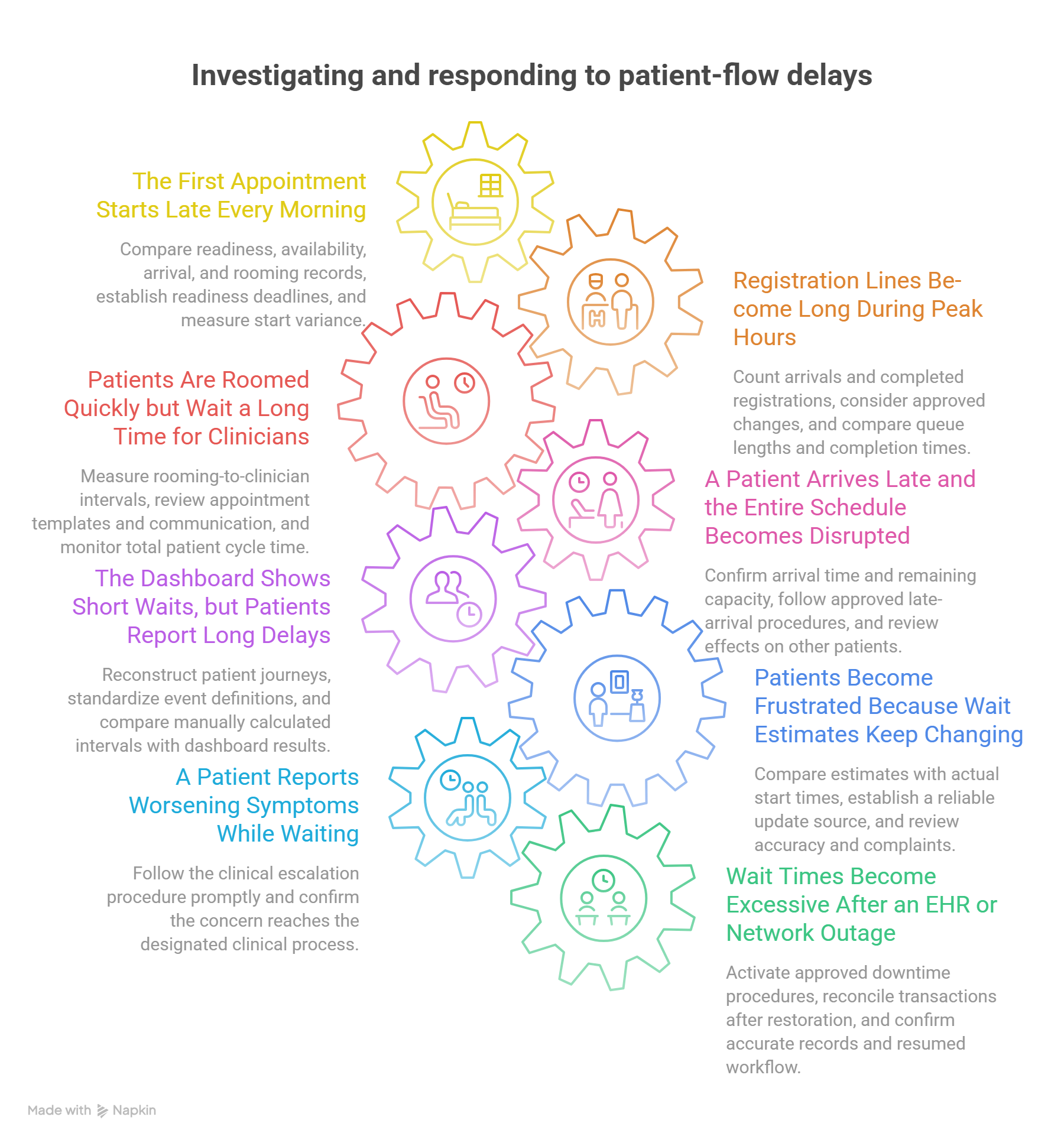
Scenario 1: The First Appointment Starts Late Every Morning
Likely causes: Delayed opening procedures, incomplete room preparation, late provider availability, or registration tasks that begin too close to the appointment time.
Investigation: Compare facility-readiness records, clinician availability, patient arrival times, and rooming timestamps. Determine whether the delay originates before registration, during preparation, or after the patient reaches the examination room.
Corrective action: Establish service-specific readiness deadlines and assign responsibility for unresolved opening tasks. Update scheduling or arrival instructions only where supported by actual workflow evidence.
Verification: Measure first-appointment start variance over several comparable sessions.
Review improvements alongside front-desk procedures, team communication, and scheduling conflict management.
Scenario 2: Registration Lines Become Long During Peak Hours
Likely causes: Clustered arrivals, inadequate service capacity, repeated information collection, or unavailable digital registration tools.
Investigation: Count arrivals and completed registrations in short intervals. Determine whether delays involve waiting for an available receptionist or completing complex registration tasks.
Corrective action: Consider approved pre-registration, staggered arrival instructions, better exception handling, or additional registration support during peak periods.
Ensure patients requiring staff assistance retain accessible registration options.
Verification: Compare registration queue lengths and completion times during equivalent periods.
Use virtual check-in systems, front-desk etiquette guidelines, and medical admin troubleshooting to support the changes.
Scenario 3: Patients Are Roomed Quickly but Wait a Long Time for Clinicians
Likely causes: Clinician workload, mismatched appointment durations, incomplete clinical handoffs, or patients being roomed substantially earlier than the provider can begin.
Investigation: Measure the interval between rooming completion and clinician contact. Compare the timestamps with provider schedules and the actual durations of preceding encounters.
Corrective action: Review appointment templates, improve room-ready communication, and investigate whether current rooming practices unnecessarily increase time spent waiting in examination rooms.
Verification: Monitor room-to-provider delay and total patient cycle time together.
Changes should be coordinated through clinical team communication, patient scheduling tools, and workflow automation.
Scenario 4: A Patient Arrives Late and the Entire Schedule Becomes Disrupted
Likely causes: An unclear late-arrival policy, overbooking, insufficient scheduling buffers, or staff attempting to insert the patient without assessing available resources.
Investigation: Confirm the actual arrival time, scheduled appointment duration, remaining capacity, and relevant organizational policies.
Corrective action: Follow approved late-arrival procedures, considering accessibility requirements and clinical escalation where appropriate.
Any additional booking or rescheduling decision should be authorized under the practice's established rules.
Verification: Review whether the decision creates additional appointment conflicts or affects other scheduled patients.
Coordinate through scheduling conflict procedures, assertive communication techniques, and patient interaction scripts.
Scenario 5: The Dashboard Shows Short Waits, but Patients Report Long Delays
Likely causes: Missing timestamps, incorrect event definitions, time recorded after the actual event, or exclusion of certain waiting stages.
Investigation: Reconstruct a sample of patient journeys using actual arrival, registration, rooming, clinician-start, and departure information.
Determine whether the dashboard measures arrival-to-room, check-in-to-provider, or another interval.
Corrective action: Standardize event definitions and repair inaccurate workflow status mappings. Document how missing timestamps affect reporting.
Verification: Compare manually calculated intervals with dashboard results and investigate material discrepancies.
Use cloud-based EMR data, medical admin troubleshooting, and workflow automation reporting.
Scenario 6: Patients Become Frustrated Because Wait Estimates Keep Changing
Likely causes: Unverified estimates, delayed provider updates, unclear communication ownership, or assumptions about how quickly the current encounter will finish.
Investigation: Compare communicated estimates with actual start times. Determine which employee supplied the estimate and what information supported it.
Corrective action: Establish a reliable source for delay updates. Communicate ranges or a defined update interval when exact timing cannot be established.
Explain appropriate options without disclosing another patient's clinical information.
Verification: Review update accuracy, patient complaints, and unresolved communication requests.
Use therapeutic communication techniques, verbal communication skills, and confidential communication practices.
Scenario 7: A Patient Reports Worsening Symptoms While Waiting
Risk: A patient's clinical condition may require reassessment or more immediate attention.
Administrative response: Follow the organization's clinical escalation procedure promptly. Communicate the reported concern to an appropriately qualified professional and document the required handoff.
Administrative staff should avoid independently assigning clinical urgency or promising that the current queue position is medically appropriate.
In emergency departments, applicable emergency-care obligations and clinical triage pathways take precedence over routine queue management.
Verification: Confirm that the concern has reached the designated clinical process.
Relevant training includes phone triage communication, team communication, and professional medical administration.
Scenario 8: Wait Times Become Excessive After an EHR or Network Outage
Likely causes: Unavailable check-in systems, failed appointment synchronization, missing queue statuses, and administrative rework after service restoration.
Investigation: Determine the outage's affected systems, duration, and impact on patient registrations and appointments.
Corrective action: Activate approved downtime procedures. Maintain authorized temporary records, protect confidential patient information, and reconcile outstanding transactions after restoration.
Avoid introducing duplicate appointment records or unsupported timestamps.
Verification: Confirm that affected patients have accurate records, unresolved tasks are assigned, and the normal workflow can be resumed.
Use medical admin technology troubleshooting, healthcare cybersecurity procedures, patient scheduling integrations, and secure messaging systems.
5. Appointment Wait-Time Management KPIs and a 14-Day Improvement Plan
A useful wait-time improvement program must establish a reliable baseline before introducing changes.
The initial goal is to identify which delays affect patients most, which stages create recurring bottlenecks, and whether proposed improvements produce measurable benefits without weakening access or clinical safety.
KPI 1: Mean Appointment Start Delay
Formula: Sum of measured appointment start delays ÷ number of appointments evaluated.
For this KPI, define delay as the number of minutes an appointment begins after its scheduled start, with early or on-time starts counted as zero.
Suppose 100 appointments accumulate 1,500 minutes of such delays. The mean delay is 15 minutes.
Segment the result by provider, visit type, and clinic session.
Use patient scheduling integrations, workflow automation reporting, and scheduling conflict management to investigate repeat patterns.
KPI 2: Percentage of Appointments Starting Within the Target Window
Formula: Appointments beginning within the defined start-time tolerance ÷ eligible appointments × 100.
A practice might adopt an internal target window based on its services and operating policies.
For illustration, if 168 of 200 eligible appointments begin within ten minutes of the scheduled time, the result is 84%.
The tolerance is an operational reporting choice rather than a universal clinical safety standard.
Review failures by visit category and resource availability through patient scheduling software, medical administrative troubleshooting, and team coordination procedures.
KPI 3: Median Patient Cycle Time
Formula: The middle recorded arrival-to-departure duration after sorting all eligible visits.
Suppose seven visits require 42, 48, 51, 57, 63, 70, and 95 minutes.
The median cycle time is 57 minutes.
This measure reflects the overall visit experience, including both waiting and service delivery.
A lower cycle time should be evaluated alongside clinical completeness, appointment type, and patient needs.
Use virtual check-in data, cloud-based EMR workflows, and healthcare automation reporting to reconstruct meaningful durations.
KPI 4: Excessive-Wait Exception Rate
Formula: Eligible visits exceeding the defined operational waiting threshold ÷ all eligible visits × 100.
If 18 of 150 eligible visits exceed the threshold, the excessive-wait exception rate is 12%.
The practice must define which waiting stage the threshold measures.
Separate registration delays from room-to-provider delays and appointment-start delays.
Investigate exceptions through scheduling conflict management, medical admin troubleshooting, and patient communication workflows.
KPI 5: Third Next Available Appointment
Measurement: Calendar days to the third eligible routine opening for a defined provider or service.
Record this metric at consistent intervals and use stable inclusion criteria.
A rising TNA may indicate an increasing appointment backlog, restricted capacity, or growing demand.
Compare the measure with continuity of care, patient preferences, and completed visit volume before drawing conclusions.
Review the data through patient scheduling integrations, appointment reminder and access workflows, and workflow automation tools.
KPI 6: Wait-Time Communication Completion Rate
Formula: Patients meeting the approved delay-notification criteria who receive a documented appropriate update ÷ all patients meeting those criteria × 100.
If 45 of 50 qualifying patients receive an appropriate update, the completion rate is 90%.
Record the timing and method of communication, using approved systems and minimal necessary information.
A completed notification should reflect an actual communication attempt or verified update under the defined measurement rules.
Monitor these actions through secure messaging tools, patient interaction scripts, and written communication procedures.
KPI 7: Timestamp Completeness and Accuracy Rate
Formula: Audited visits with all required, valid workflow timestamps ÷ total visits audited × 100.
If 186 of 200 reviewed records contain the required accurate timestamps, the result is 93%.
Check event order, missing values, unusually identical timestamps, and delayed status entries.
An automated timestamp generated when a note is finalized may be unsuitable as a measure of when the clinician actually entered the room.
Audit timestamp integrity using cloud-based EMR functionality, technical troubleshooting procedures, and workflow automation reporting.
A Practical 14-Day Wait-Time Improvement Plan
Days 1–2: Establish measurement definitions. Decide which events count as arrival, check-in completion, rooming completion, clinician start, and departure. Identify which software records each event and whether those timestamps can be trusted.
Days 3–4: Collect baseline data. Measure wait times across different providers, appointment types, locations, and clinic sessions. Record delay reasons using agreed definitions and review data quality.
Days 5–6: Identify dominant bottlenecks. Compare queue lengths and service capacity. Determine whether delays originate in scheduling, registration, rooming, clinician availability, or departure processes.
Days 7–8: Design one targeted change. Adjust an approved template, improve a handoff, change a patient arrival instruction, or introduce an appropriate operational alert. Document expected benefits and potential unintended effects.
Days 9–11: Conduct a limited pilot. Test the intervention in a defined service area. Maintain existing clinical escalation safeguards and monitor whether delays move to other parts of the workflow.
Days 12–13: Audit outcomes. Compare median waits, long-wait exceptions, cycle time, and staff rework. Check whether timestamp quality or patient communication changed during the pilot.
Day 14: Review and assign next actions. Retain effective improvements, investigate unresolved problems, and identify the next bottleneck requiring attention.
The rollout should involve patient scheduling teams, front-desk administrators, clinical communication staff, and personnel responsible for healthcare workflow automation.
A 14-day pilot can identify operational defects and early improvements. Sustained performance should be evaluated over longer periods, particularly where seasonal demand, provider absences, and patient complexity vary considerably.
6. Frequently Asked Questions About Appointment Wait-Time Management
-
Appointment wait time describes a specific delay, such as the interval before an appointment becomes available or the time a patient waits before seeing a clinician.
Patient cycle time measures the entire duration between defined arrival and departure events.
A patient could spend 75 minutes in a clinic while receiving 45 minutes of active care and experiencing 30 minutes of waiting.
Track these components separately through patient scheduling integrations, virtual check-in systems, and cloud-based EMR records.
-
Begin by defining the waiting stage and reviewing historical performance.
Compare mean, median, and upper-percentile waits across similar services. Include patient-reported experiences and the effect of long delays on care access.
Set operational review thresholds using the practice's service standards, patient needs, and applicable requirements.
Potentially urgent clinical concerns require immediate escalation under approved protocols, regardless of the operational threshold.
Use phone triage communication guidance, scheduling conflict procedures, and team communication workflows.
-
The earliest opening may result from an isolated cancellation. The third eligible opening can offer a more stable measure of routine appointment capacity.
To calculate the metric, identify the third eligible appointment for a consistent provider and visit category, then count calendar days from the observation date.
Exclude restricted slots according to the measurement protocol.
Track the result at comparable observation times.
Use patient scheduling tools, scheduling conflict management, and workflow automation reporting to monitor access trends.
-
Digital check-in may reduce registration work by allowing patients to complete approved administrative tasks before arriving.
Potential benefits include less repetitive data entry and more predictable registration workflows.
Actual results depend on system design, patient participation, accessibility, and integration reliability.
Some patients still require staff assistance or additional verification.
Measure changes in registration completion time and waiting-room dwell time using virtual check-in software, medical front-desk workflows, and healthcare automation tools.
-
Staff should explain verified information, provide an appropriate estimate or future update interval, and describe available options under clinic policy.
Avoid attributing delays to another patient's private medical circumstances.
Acknowledge the inconvenience and ask whether the patient needs assistance with an approved rescheduling or communication request.
If the patient reports worsening symptoms, follow the established clinical escalation process.
Useful training includes patient interaction scripts, verbal communication skills, therapeutic communication, and confidential communication.
-
Overbooking requires careful review of provider authorization, actual patient demand, appointment complexity, resource capacity, and organizational policy.
Historical no-show patterns may be relevant to planning, but predictions can be inaccurate for individual patients.
An additional booking can create substantial delays if more patients attend than anticipated.
Evaluate alternative approaches such as qualified waitlist matching, appropriate reminders, and recovering canceled capacity.
Review appointment reminder software, patient scheduling integrations, and scheduling conflict management.
